
Understanding Article 17: A Legal Safeguard Against Discrimination
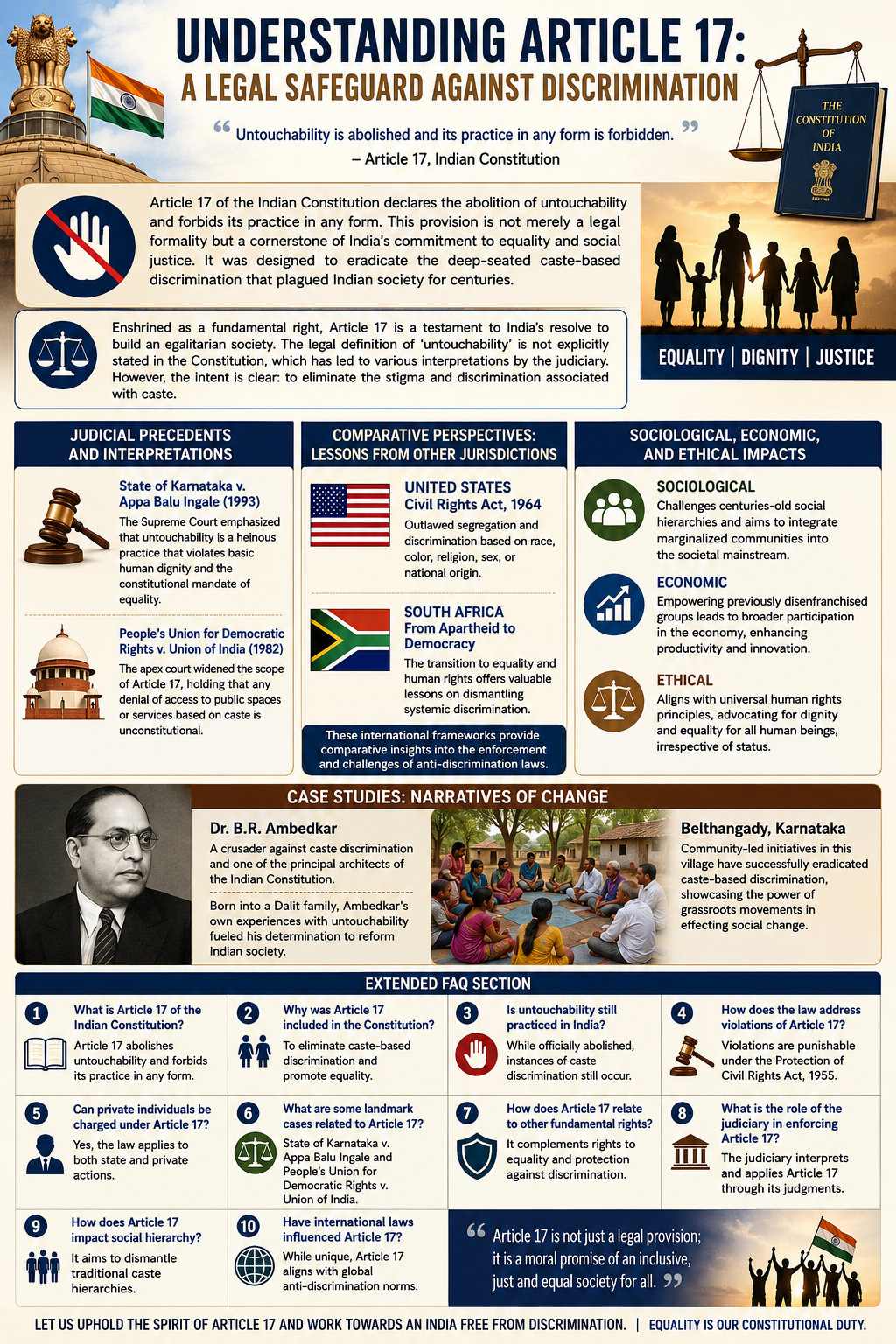
Article 17 of the Indian Constitution declares the abolition of untouchability and forbids its practice in any form. This provision is not merely a legal formality but a cornerstone of India's commitment to equality and social justice. It was designed to eradicate the deep-seated caste-based discrimination that plagued Indian society for centuries.
Enshrined as a fundamental right, Article 17 is a testament to India's resolve to build an egalitarian society. The legal definition of 'untouchability' is not explicitly stated in the Constitution, which has led to various interpretations by the judiciary. However, the intent is clear: to eliminate the stigma and discrimination associated with caste.
Judicial Precedents and Interpretations
The Supreme Court of India, through various judgments, has reinforced the prohibition of untouchability. In the landmark case of State of Karnataka v. Appa Balu Ingale, the court emphasized that untouchability is a heinous practice that violates basic human dignity and the constitutional mandate of equality.
Another significant case is People’s Union for Democratic Rights v. Union of India, where the apex court widened the scope of Article 17, holding that any denial of access to public spaces or services based on caste is unconstitutional.
Comparative Perspectives: Lessons from Other Jurisdictions
Globally, the fight against discrimination has taken various forms. The United States' Civil Rights Act of 1964 is a pivotal law that outlawed segregation and discrimination based on race, color, religion, sex, or national origin. South Africa’s journey from apartheid to a democratic society also offers valuable lessons. These international frameworks provide comparative insights into the enforcement and challenges of anti-discrimination laws.
Sociological, Economic, and Ethical Impacts
The abolition of untouchability has profound sociological implications. It challenges centuries-old social hierarchies and aims to integrate marginalized communities into the societal mainstream. Economically, empowering previously disenfranchised groups can lead to broader participation in the economy, enhancing productivity and innovation.
Ethically, Article 17 aligns with universal human rights principles, advocating for dignity and equality for all human beings. It asserts that every individual deserves respect, irrespective of their social or economic status.
Case Studies: Narratives of Change
Consider the story of Dr. B.R. Ambedkar, a crusader against caste discrimination and one of the principal architects of the Indian Constitution. Born into a Dalit family, Ambedkar's own experiences with untouchability fueled his determination to reform Indian society.
Another inspiring narrative is that of the village of Belthangady in Karnataka, where community-led initiatives have successfully eradicated caste-based discrimination, showcasing the power of grassroots movements in effecting social change.
Extended FAQ Section
- What is Article 17 of the Indian Constitution? - Article 17 abolishes untouchability and forbids its practice in any form.
- Why was Article 17 included in the Constitution? - To eliminate caste-based discrimination and promote equality.
- Is untouchability still practiced in India? - While officially abolished, instances of caste discrimination still occur.
- How does the law address violations of Article 17? - Violations are punishable under the Protection of Civil Rights Act, 1955.
- Can private individuals be charged under Article 17? - Yes, the law applies to both state and private actions.
- What are some landmark cases related to Article 17? - State of Karnataka v. Appa Balu Ingale and People’s Union for Democratic Rights v. Union of India.
- How does Article 17 relate to other fundamental rights? - It complements rights to equality and protection against discrimination.
- What is the role of the judiciary in enforcing Article 17? - The judiciary interprets and applies Article 17 through its judgments.
- How does Article 17 impact social hierarchy? - It aims to dismantle traditional caste hierarchies.
- Have international laws influenced Article 17? - While unique, Article 17 aligns with global anti-discrimination norms.
Op-Ed: Reflecting on the Journey and Future of Article 17
Article 17 stands as a beacon of hope in India's constitutional framework, symbolizing the nation's resolve to transcend centuries-old social divisions. While the legal prohibition of untouchability marks a significant step forward, the journey towards a truly egalitarian society continues.
Despite the constitutional mandate, the reality on the ground often tells a different story. Instances of caste-based discrimination, though reduced, still persist in various parts of the country. This discrepancy between law and practice underscores the need for continued vigilance and enforcement, both by governmental agencies and civil society.
The socio-economic integration of marginalized communities remains a critical challenge. While legal measures provide a foundation, economic empowerment and educational opportunities are essential to enable these communities to rise above historical injustices. Initiatives aimed at skill development and educational access can play a transformative role in this regard.
Ethically, the abolition of untouchability resonates with universal human rights values, advocating for a society where every individual is treated with dignity and respect. This ethical imperative must guide not only legal frameworks but also societal attitudes and behaviors.
Comparatively, India's journey offers valuable lessons to other nations grappling with similar issues of discrimination and social stratification. The experiences of countries like the United States and South Africa highlight the importance of sustained legal and social efforts to combat discrimination.
Looking ahead, the future of Article 17 lies in its ability to adapt and respond to evolving societal challenges. As new forms of discrimination and social exclusion emerge, the legal framework must be robust enough to address these issues effectively. Public awareness and education on the values enshrined in Article 17 are crucial to fostering an inclusive society.
In conclusion, while Article 17 has laid the groundwork for eradicating untouchability, the onus is on every citizen to uphold and propagate its principles. By embracing the spirit of equality and justice, India can continue its journey towards a society that truly reflects the ideals of its Constitution.