
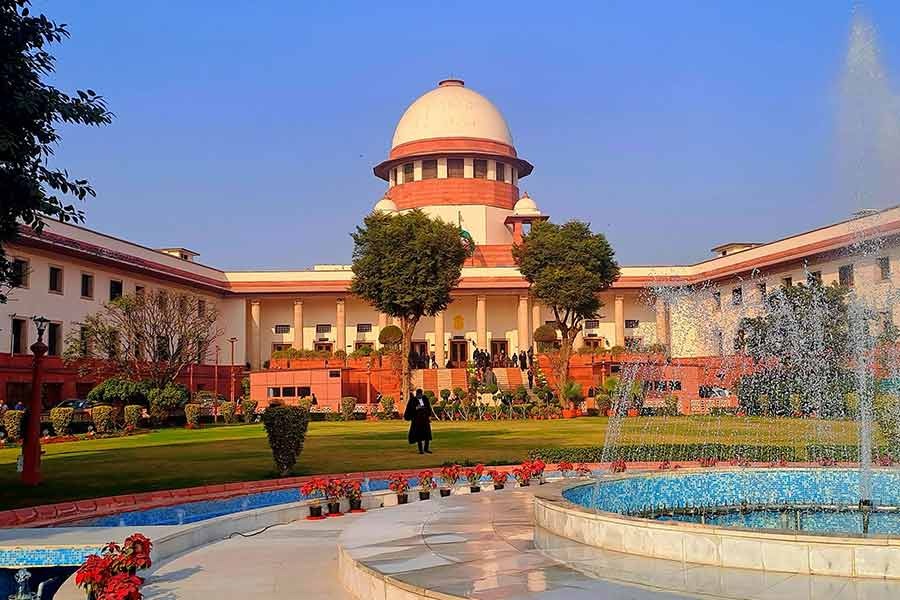
Law Does Not Favour the Indolent
Apex Court Quashes Arbitration After 21-Year Delay
Limitation Act Applies Strictly to Arbitration Claims
By Legal Reporter
New Delhi: April 15, 2026:
The Supreme Court has once again underscored the principle that limitation laws apply with full force to arbitration proceedings, refusing to allow stale claims to be revived decades after the cause of action arose. In a recent judgment, the Court set aside arbitration initiated by a contractor against the State of West Bengal, noting that the invocation came 21 years after completion of work—a delay that rendered the claim ex facie time-barred.
Case Title: Shailendra Kumar Jain & Others v. Maya Prakash Jain & Others .
For insights into inheritance disputes, family property rights, and succession law principles, read the full Supreme Court judgment here: Shailendra Kumar Jain vs Maya Prakash Jain Supreme Court judgment on inheritance and property law .
Case Background
The contractor completed the assigned work on July 30, 2000. Despite correspondence in early 2001, no arbitration was invoked until June 2, 2022. The Calcutta High Court had earlier appointed an arbitrator under Section 11 of the Arbitration and Conciliation Act, 1996, but the State challenged this before the Supreme Court.
Key Legal Provisions Discussed
- Section 43, Arbitration and Conciliation Act, 1996
- Explicitly applies the Limitation Act, 1963 to arbitration proceedings.
- Ensures arbitration is not treated as a parallel system immune from statutory timelines.
- Article 137, Limitation Act, 1963
- Governs applications under Section 11(6) for appointment of arbitrators.
- Prescribes a three-year limitation period from the date the right to apply accrues.
- Principle of Dead Claims
- Courts must reject claims that are prima facie barred by limitation.
- Arbitration cannot be used as a refuge for indolent litigants who fail to act diligently.
Court’s Reasoning
The Court emphasized that arbitration is meant to provide speedy resolution of disputes, not to resurrect claims long buried. The contractor’s reliance on the Engineer-in-Charge’s failure to issue a final bill was rejected. The Court held that such administrative lapses do not extend limitation indefinitely. Once the cause of action arose in 2001, the contractor had three years to invoke arbitration. Waiting until 2022 was fatal.
Precedents Cited
- Arif Azim Co. Ltd. v. Aptech Ltd.: Confirmed that limitation laws apply to arbitration.
- Other rulings reiterating that arbitration cannot override statutory limitation periods.
Implications
- For Contractors: Vigilance is essential. Delay in invoking arbitration can extinguish claims permanently.
- For Government Entities: Provides protection against stale claims being revived decades later.
- For Courts: Reinforces the duty to reject time-barred claims at the threshold, ensuring judicial efficiency.
- For Arbitration Practice: Strengthens credibility of arbitration as a timely dispute resolution mechanism.
FAQ: Quick Guide to the Legal Points
Q1: Does the Limitation Act apply to arbitration?
Yes. Section 43 of the Arbitration Act makes the Limitation Act applicable to arbitration proceedings.
Q2: What is the limitation period for invoking arbitration?
Generally, three years under Article 137 of the Limitation Act for applications under Section 11(6).
Q3: Can administrative delays (like non-issuance of a final bill) extend limitation?
No. The Supreme Court held that such delays do not extend limitation indefinitely.
Q4: What happens if arbitration is invoked after decades?
Such claims are considered ex facie dead and will be rejected outright.
Q5: Why did the Supreme Court quash arbitration in this case?
Because the contractor waited 21 years after completion of work to invoke arbitration, far beyond the limitation period.
Q6: What precedent supports this ruling?
The Court relied on Arif Azim Co. Ltd. v. Aptech Ltd., among others, confirming limitation applies to arbitration.
Q7: What principle underlies this ruling?
That law favours the diligent, not the indolent rights must be enforced promptly.
Conclusion
This judgment is a strong reminder that arbitration is not a backdoor to revive forgotten claims. By quashing proceedings initiated after two decades, the Supreme Court has reinforced the discipline of limitation law and ensured arbitration remains a mechanism for timely and efficient dispute resolution. Both contractors and government agencies must now act with urgency when disputes arise, or risk losing their claims forever.