
Watch the Video
In this 5-minute video, Vineet Kohli, Advocate explains, in Episode 23 of “DRT Act Explained with Judgments”, the right of appeal to the DRAT under Section 20 and the pre-deposit under Section 21 of the Recovery of Debts and Bankruptcy Act, 1993, including the changes made in 2016. This article walks through the same points: who can appeal, the 30-day limit, how the DRAT decides, and what the borrower must deposit before his appeal is heard.
Lost Before the DRT? The Next Step Is the DRAT
A single Presiding Officer decides a case before the Debts Recovery Tribunal. If a party thinks the order is wrong, the Recovery of Debts and Bankruptcy Act, 1993 gives a right of appeal to the Debts Recovery Appellate Tribunal (DRAT). But for a borrower, that appeal comes at a price: the pre-deposit. This episode explains both.
Section 20(1) and (2): The Right of Appeal
Under Section 20(1), any person aggrieved by an order made, or deemed to have been made, by a DRT can appeal to the DRAT having jurisdiction over that Tribunal. This includes the bank as well as the borrower or guarantor.
Section 20(2) adds one important exception: no appeal lies against an order made with the consent of the parties. So a settlement recorded by the DRT is final, and a party who agreed to it cannot later appeal against it.
Section 20(3): Thirty Days to Appeal
The appeal must be filed within 30 days from the date on which a copy of the order is received by the appellant.
- Before the 2016 amendment, the period was 45 days. Many older books still say so, so check the current bare act.
- The DRAT can entertain an appeal after 30 days if it is satisfied that there was sufficient cause for not filing it in time.
Unlike the strict 45-day outer limit for a written statement under Section 19(5), the appeal period can be extended for sufficient cause, because Section 20(3) itself allows it.
Hearing and Disposal
After giving the parties an opportunity of being heard, the DRAT can confirm, modify or set aside the DRT’s order. It sends a copy of its order to the parties and to the DRT concerned, and it must try to dispose of the appeal finally within six months from the date it is received.
Section 20 also covers appeals to the DRAT under the Insolvency and Bankruptcy Code, which the DRAT hears in individual and partnership insolvency matters.
Section 21: The Pre-deposit
This is the provision that matters most to borrowers. Under Section 21, where an appeal is filed by any person from whom the amount of debt is due to a bank or financial institution, the appeal will not be entertained unless he has deposited 50% of the amount of debt so due, as determined by the DRT under Section 19.
- The DRAT may, for reasons recorded in writing, reduce the deposit, but not below 25% of the debt.
- Before 2016, the deposit was 75%, and the Appellate Tribunal could waive it or reduce it. The 2016 amendment lowered the deposit but removed the power to waive.
- The deposit applies to the debtor, the person from whom the debt is due. A bank that appeals does not have to make it.
Remember this line: 50% to appeal, never less than 25%, and no waiver.
Judicial View: Narayan Chandra Ghosh v. UCO Bank (2011)
The Supreme Court has consistently upheld pre-deposit conditions as a check on appeals filed only to delay recovery.
In Narayan Chandra Ghosh v. UCO Bank and Others, (2011) 4 SCC 548, decided on 18 March 2011, the Court considered the similar pre-deposit under Section 18 of the SARFAESI Act. It held that the deposit is a condition precedent for an appeal, and that the Appellate Tribunal cannot entertain the appeal without it. Its only power is to reduce the deposit, for recorded reasons, down to the statutory minimum of 25%; it cannot waive it.
The same reasoning applies to Section 21 of the DRT Act, and the Supreme Court relied on it when dealing with Section 21 in later cases, which the next episode covers.
Guarantors must deposit too
A guarantor against whom the DRT has passed an order is also a person from whom the debt is due. If he appeals, he must make the pre-deposit just like the principal borrower.
Practical Illustration: The Company and the Guarantor
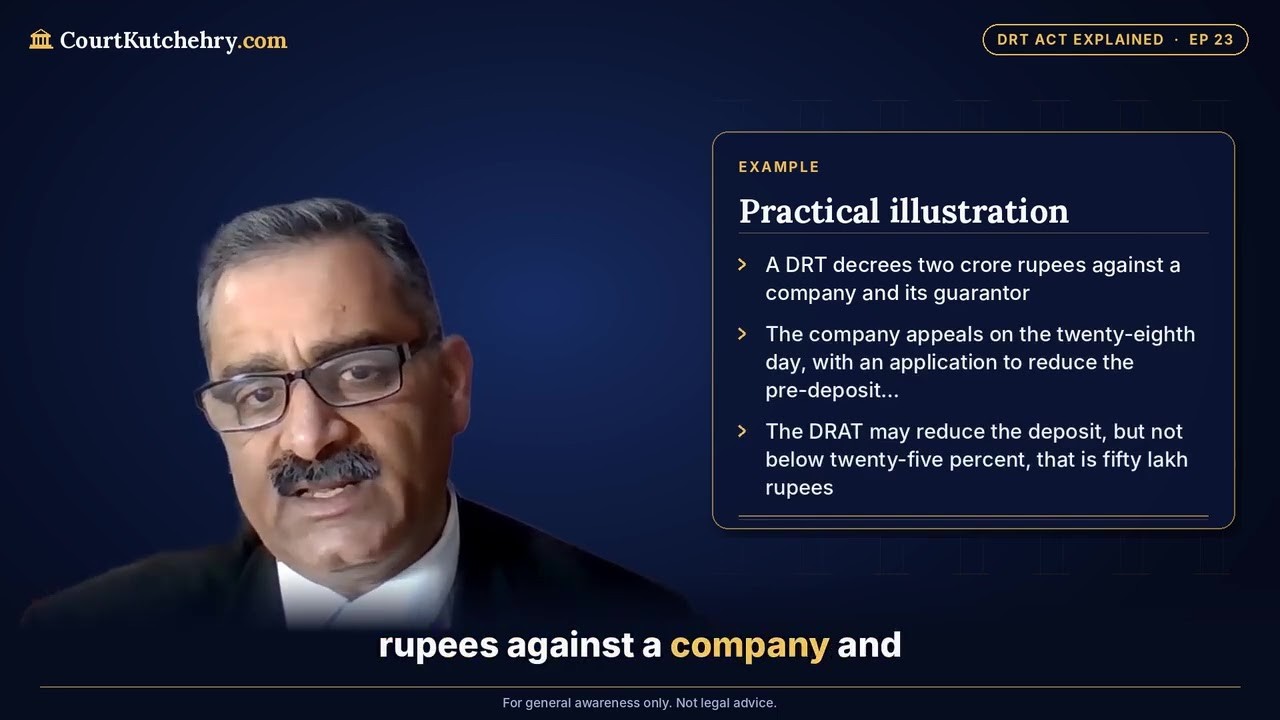
The DRT decrees ₹2 crore against a company and its guarantor.
- The company appeals on day 28, within time. It asks for a reduced deposit because its bank accounts are frozen. The DRAT can reduce the deposit from ₹1 crore (50%), but not below ₹50 lakh (25%). Without at least that, the appeal will not be heard.
- The guarantor appeals on day 40, after the 30 days. He must show sufficient cause for the delay, and he must also make the pre-deposit.
- If the parties had settled before the DRT and the order had been passed with their consent, there would be no appeal at all.
Key Takeaways
- Any person aggrieved by a DRT order can appeal to the DRAT under Section 20(1), but no appeal lies from a consent order (Section 20(2)).
- The appeal must be filed within 30 days of receiving a copy of the order (45 days before 2016); delay can be condoned for sufficient cause.
- The DRAT can confirm, modify or set aside the order, and should decide the appeal within six months.
- Under Section 21, a debtor must deposit 50% of the debt determined by the DRT; the DRAT can reduce it with reasons, but not below 25%, and cannot waive it.
- Guarantors who appeal must also deposit; a bank that appeals need not.
Frequently Asked Questions
What is the limitation period for an appeal to the DRAT?
Thirty days from the date of receiving a copy of the DRT’s order, under Section 20(3). The DRAT can admit a late appeal if there was sufficient cause.
How much pre-deposit is required to appeal to the DRAT?
Fifty per cent of the debt as determined by the DRT. The DRAT may reduce it, for reasons recorded in writing, but not below 25%.
Can the DRAT waive the pre-deposit completely?
No. The power to waive was removed in 2016. The DRAT can only reduce the deposit to a minimum of 25%.
Can I appeal against a settlement recorded by the DRT?
No. Section 20(2) says no appeal lies against an order made with the consent of the parties.
Does a bank have to make a pre-deposit to appeal?
No. Section 21 applies to an appeal by a person from whom the debt is due, not to the bank or financial institution.
Where can I watch the full explanation?
Watch Vineet Kohli, Advocate explain it in 5 minutes: https://youtu.be/WFJAAnmLaOg.
Conclusion
Sections 20 and 21 give every aggrieved party a right of appeal to the DRAT, within 30 days, except against a consent order. But for the borrower and the guarantor, the appeal opens only after the pre-deposit: 50% of the debt determined, which the DRAT can bring down to 25% and no lower.
The Supreme Court’s approach, from Narayan Chandra Ghosh onwards, is that this deposit is a condition precedent, designed to stop appeals filed only to delay recovery.
▶ Watch the video: Appeal to DRAT: 30-Day Limit & 50% Pre-deposit | Sections 20 & 21 | DRT Act Ep 23
Research Judgments Like These on CourtKutchehry
Every judgment cited in this article, and lakhs more, can be searched and read on CourtKutchehry. Searching and reading judgments is free. A membership adds unlimited summaries, all related judgments, original court PDF downloads, bookmarks, notes and the CourtKutchehry AI assistant.
| Membership | Price | Works out to | AI credits |
|---|---|---|---|
| Monthly (1 month) | ₹599 | ₹599 / month | 1,000 / month |
| Quarterly (3 months) · Save 16% | ₹1,499 | ₹499.67 / month | 1,100 / month |
| Six-monthly (6 months) · Save 33% | ₹2,399 | ₹399.83 / month | 1,200 / month |
| Yearly (12 months) · Save 44% · Best value | ₹3,999 | ₹333.25 / month | 1,300 / month |
Every plan is a one-off purchase for a fixed period: nothing auto-renews and no card is kept on file. Prices are exclusive of applicable tax, which is added at checkout. Extra AI chat credits can be topped up from ₹99. A free verified account gets 5 summaries and 50 AI trial credits.
Prices are as displayed on courtkutchehry.com on 20 November 2026 and are subject to change without notice. Please check the pricing page for the current plans and offers.
For more judgments, legal opinions and case analysis, visit courtkutchehry.com
Visit CourtKutchehry →