

COURTKUTCHEHRY SPECIAL SERIES ON LANDMARKS JUDGEMENTS ON WILLS, CODICIL & PROBATE
Apoline D’Souza v. John D’Souza: Supreme Court Rejects Suspicious 1992 Will
Handwritten Notes, Thumb Mark, and Over-Writings Raise Doubts
Propounder Failed to Prove Due Execution and Attestation
By Vishwas Kumar
New Delhi: March 24, 2026:
In Apoline D’Souza v. John D’Souza (Civil Appeal No. 4608 of 2003, decided on 16 May 2007), the Supreme Court of India delivered a decisive ruling on the proof and validity of Wills under succession law. The Division Bench comprising Hon’ble Mr. Justice S.B. Sinha and Hon’ble Mr. Justice Markandey Katju examined the disputed Will of Florine D’Souza, executed in 1992.
The trial court had accepted the Will as genuine, but the High Court reversed this finding, citing multiple suspicious circumstances. These included inconsistencies between handwritten and typed portions of the document, an unidentified thumb impression, the absence of clarity about the scribe, and several over-writings. Such irregularities cast serious doubt on the authenticity of the Will.
On appeal, the Supreme Court upheld the High Court’s decision. The Bench emphasized that the burden lies on the propounder to prove due execution and attestation in accordance with law. In this case, the propounder failed to remove the cloud of suspicion and did not establish compliance with statutory requirements. As a result, the Will was held not proved, and the appeal was dismissed.
This judgment reinforces the principle that Wills must be proved with unimpeachable evidence, and any unexplained irregularities—whether in execution, attestation, or document integrity—can invalidate them. The ruling serves as a cautionary precedent, highlighting that courts will not uphold testamentary documents unless all doubts are convincingly dispelled.
For More, Read Here the Summary of the Judgement from the Book: WILL WRITING SIMPLIFIED, read below or open page no 436, Chapter 14.1 in the book. (Online book purchase link available here on: Buy online: Amazon | Flipkart
|
|
Case Summary |
: |
Apoline D’Souza v. John D’Souza. |
|
|
Court |
: |
Supreme Court of India |
|
|
Citations |
: |
(2007) 05 SC CK 0070: Civil Appeal No. 4608 of 2003. |
|
|
Link |
: |
https://www.courtkutchehry.com/judgements/659802/apoline-dsouza-vs-john-dsouza/
|
|
|
Decided on |
: |
16 May 2007 |
|
|
Coram |
: |
Hon’ble Mr. Justice S.B. Sinha and Hon’ble Mr. Justice Markandey Katju. (Division Bench) |
|
|
Relevant Paragraphs |
: |
Para Nos. 2 - 21 |
1. Facts of the Case
(i). Florine D’Souza executed a Will on 06 May 1992. She had two daughters, both nuns—Olivia (d. 1975) and Olympia (d. 1993). The appellant Apoline D’Souza, unrelated to the testatrix, was one of the beneficiaries. Under the Will, property “A” was bequeathed to the appellant and property “B” to the respondent John D’Souza. Florine died on 13 March 1994. Appellant sought Letters of Administration u/s 276 Succession Act 1925. Respondent caveated, alleging the testatrix was aged, infirm and not of sound mind when executing the Will.
(ii). The Trial Court held execution proved and found no suspicious circumstances, observing that the disposition was natural. The High Court reversed, finding serious defects: attesting witness (PW-2) signed a handwritten document while the Will produced was typed in Kannada, containing over-writings and cuttings; PW-2 did not identify the testatrix’s thumb impression; and mere registration did not prove due execution.
2. Law Points Involved
(i). Proof of execution and attestation of a Will.
(ii). Existence of suspicious circumstances and the onus on the propounder to remove them.
(iii). Effect of registration of a Will and its non-conclusive nature.
(iv). Role of attesting witness and requirement of animus attestandi.
(v). Burden of proof under Sections 63 Succession Act and 68 Evidence Act.
3. Acts / Provisions / Articles Referred
(i). Indian Succession Act, 1925: Sections 63 & 276
(ii). Indian Evidence Act, 1872: Section 68
4. Judgments Referred
(i). H. Venkatachala Iyengar v. B.N. Thimmajamma (1958) 11 SC CK 0008;
(ii). B. Venkatamuni v. C.J. Ayodhya Ram Singh, (2006) 10 SC CK 0054.
(iii). S. Sankaran v. D. Kausalya, (2007) 02 SC CK 0092.
https://www.courtkutchehry.com/judgements/660197/s-sankaran-appellant-hash-d-kausalya-respondent]
(iv). Benga Behera v. Braja Kishore Nanda, (2007) 05 SC CK 0175.
(v). Naresh Charan Das Gupta v. Paresh Charan Das Gupta, (1954) 12 SC CK 0012.
5. Obiter Dicta
(i). Mere compliance with statutory formalities does not ipso facto prove a Will.
(ii). Even registration does not dispense with the requirement of proving execution and attestation.
(iii). Suspicious circumstances must be examined carefully; the court must not begin with distrust but must seek truth with judicial scrutiny.
(iv). Each case depends on its own facts; no universal rule applies to suspicious circumstances.
6. Ratio Decidendi
For valid proof of a Will, the propounder must establish due execution and attestation as mandated by Sections 63 Succession Act and 68 Evidence Act. Attestation must be proved by at least one attesting witness alive and capable of giving evidence, showing that the testator signed voluntarily with sound disposing mind. Suspicious circumstances (such as over-writings, unknown scribe or witnesses, typed vs handwritten versions, lack of proof of reading over to testatrix) must be removed by cogent evidence; failing which the Will cannot be accepted as genuine.
7. Final Ruling
The Supreme Court dismissed the appeal, upholding the High Court’s finding that the Will was not proved in accordance with law and was surrounded by suspicious circumstances. Held that the propounder failed to discharge the burden of proof under Sections 63 and 68. Appeal dismissed. No order as to costs.
8. Gist Highlighting Dispute and Final Decision
Dispute concerned proof and validity of Florine D’Souza’s Will (1992). Trial Court accepted Will as genuine; High Court reversed for want of proof and presence of suspicious circumstances (handwritten vs typed text, unidentified thumb mark, unknown scribe, over-writings). Supreme Court affirmed the High Court, holding that propounder failed to remove doubt and did not prove due execution and attestation as required by law. Will held not proved; appeal dismissed.
Read full Judgement Here:
Apoline D’Souza v. John D’Souza.
Supreme Court of India
(2007) 05 SC CK 0070: Civil Appeal No. 4608 of 2003.
https://www.courtkutchehry.com/judgements/659802/apoline-dsouza-vs-john-dsouza/
You Can Also Purchase the Book from here on: Buy online: Amazon | Flipkart
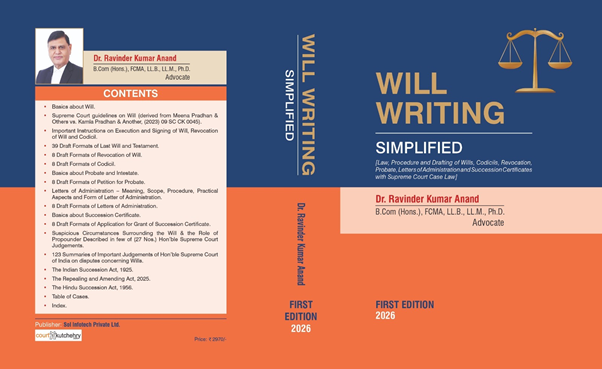
OUR RECOMMENDATION: Check out 123 Key Judgements, as highlighted in the book, WILL WRITING SIMPLIFIED, for the quick research and reference purposes. Click the link here: https://www.courtkutchehry.com/pages/blog/123-supreme-court-judgments-on-wills/
Keywords: Apoline D’Souza v. John D’Souza, Supreme Court of India 2007, Civil Appeal No. 4608 of 2003, Justice S.B. Sinha, Justice Markandey Katju, Florine D’Souza Will dispute, suspicious circumstances in Will, proof of attestation, handwritten vs typed Will, thumb impression validity, Indian succession law.