
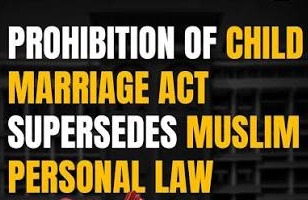
Law Prevails Over Shariat: Allahabad High Court Sets Paradigm Shift in Child Marriage Jurisprudence
The Primacy of Statutory Protection Over Personal Law Exceptions
Balancing National Public Health and Minority Rights in Modern Judicial Interpretation
By Legal Editor
New Delhi: July 08, 2026:
In a progressive and highly anticipated judgment delivered by the High Court of Judicature at Allahabad, the Indian judiciary has reinforced the supremacy of statutory protections over personal law custom. Decided on July 1, 2026, in the seminal matter of Rubi Vs State of UP, a Division Bench comprising Justice JJ Munir and Justice Achal Sachdev unequivocally ruled that no personal law, including Muslim personal law governed by the Shariat, can override or dilute the mandate of the or the stringent protections of the . This landmark decision establishes that the prohibition against minor marriages is a universal statutory mandate designed to safeguard public health and statutory children’s rights, applying to every citizen of India irrespective of religious affiliation.
Understanding how the Supreme Court has interpreted matrimonial disputes is essential for anyone dealing with divorce, judicial separation, maintenance, child custody, or mutual consent proceedings. Explore our comprehensive guide on landmark Supreme Court divorce case judgments in India to learn about key legal principles, important precedents, and the evolving approach of Indian courts under matrimonial laws.
The legal confrontation arose from a First Information Report (FIR) registered on February 15, 2026, at the Kakor police station in Bulandshahr, Uttar Pradesh. According to prosecution records, local police personnel and elements of the Child Line team received actionable intelligence regarding the imminent solemnization of a marriage involving a 16-year-old Muslim girl. When State machinery intervened to rescue the child and produce her before the local Child Welfare Committee, they were met with violent resistance. Nineteen individuals allegedly obstructed the state workers, hurled verbal abuse, threatened the enforcement unit, and forcibly took the minor girl away from official custody. Seeking to escape criminal liability, the accused filed a writ petition under Article 226 of the Constitution, praying for the quashing of the FIR on the grounds that traditional Muslim personal law legally recognizes a minor girl’s competence to wed upon attaining puberty, which is conventionally presumed at fifteen years of age.
Rejecting the defence’s contentions at the threshold, the High Court declined to quash the FIR, holding that the allegations prima facie disclosed a deliberate, punishable obstruction of public servants discharging their lawful duties. Beyond the factual determination, the Bench seized the opportunity to settle a complex legal intersection: whether the traditional right of religious communities to govern their personal marriages can form a viable defence against contemporary special statutes criminalizing minor marital unions and sexual relationships with children.
+-----------------------------------------------------------------------------------+
| CHRONOLOGY OF LEGAL FINDINGS |
+-----------------------------------------------------------------------------------+
| Feb 15, 2026: State authorities block the child marriage of a 16-year-old girl. |
| Feb 2026: Accused petition HC under Personal Law, claiming puberty validates marriage. |
| July 1, 2026: Allahabad HC rejects plea; rules PCMA and POCSO override Shariat. |
+-----------------------------------------------------------------------------------+
Analysing the Statutory Overlap: PCMA, POCSO, and Shariat Laws
To fully appreciate the scope of Rubi Vs State of UP, one must dissect the direct conflict between the , and the rules of uncodified Muslim personal law derived from Shariat principles. Traditional uncodified Islamic jurisprudence dictates that a girl who has achieved puberty possesses the capacity to enter into a valid contract of marriage. Historically, this custom has been treated as an exception to general laws governing legal majority, such as the Indian Majority Act, 1875.
However, the Bench noted that the PCMA is an all-encompassing, secular social reform statute. In its explicit terms, the Act defines a "child" as a male who has not completed twenty-one years of age and a female who has not completed eighteen years of age. The High Court emphasized that the legislature intended the PCMA to operate as an absolute prohibition on minor marriages, making no distinction based on faith. The judgment states:
"The Shariat Law providing for puberty as the competent age under the law permissible for a girl to marry or be married, runs clearly in the teeth of the PCMA as well as the POCSO Act. The age of marriage, in our considered opinion, for every citizen of the country, irrespective of religion, is that that is spelt out by the Prevention of Child Marriage Act."
Furthermore, the Court addressed the intersection between child marriage and the . Because sexual relations are an intrinsic, inseparable reality of marriage, permitting a girl under eighteen to wed effectively creates a legal shield for what the law defines as statutory rape. Under the POCSO framework, a child is anyone under eighteen, and any sexual contact involving a minor is a non-bailable, strictly punishable offense, regardless of consent or marital status. By positioning the PCMA and POCSO as statutes rooted in public health, scientific understanding, and national welfare, the High Court effectively closed the loophole of utilizing matrimonial customs as an exception to escape severe criminal charges under child safety laws.
Judicial Consensus and the Precedent of Overriding Statutes
The decision in Rubi Vs State of UP adds to an evolving legal consensus across different High Courts in India. Over the years, individual benches have issued conflicting opinions, with some earlier decisions granting relief under personal law customs, thereby highlighting an urgent need for an authoritative ruling from the Supreme Court of India. The Apex Court had noted this lack of uniformity, pointing out the persisting legal uncertainty regarding whether personal laws could prevail over the PCMA. While a legislative remedy was introduced via a proposed 2021 amendment intended to grant explicit overriding powers to the PCMA over all personal laws, the Allahabad High Court observed that the Bill had officially lapsed following the dissolution of the 17th Lok Sabha.
In the absence of a surviving legislative amendment, the High Court relied upon established principles of statutory interpretation to resolve the dilemma. The Bench aligned itself with a landmark ruling delivered by the Kerala High Court, which held that child marriage bans apply universally to all citizens, irrespective of religion.
The Court invoked the legal canon that a subsequent, specific, and all-encompassing social statute must take precedence over prior archaic exceptions. While ancient laws and the Indian Majority Act, 1875, historically carved out spaces for personal laws regarding marriage and adoption, the introduction of the PCMA and POCSO created a strict criminal and regulatory network that leaves no room for exemptions. The Bench observed that while a child marriage celebrated in violation of the PCMA might technically be voidable rather than entirely void ab initio, the actual execution, arrangement, and performance of such a marriage by guardians, adults, or third parties remains a strictly punishable offense under the law.
+---------------------------------------------+
| Indian Majority Act, 1875 |
| (Carved out personal law exemptions) |
+---------------------------------------------+
|
v
+---------------------------------------------+
| Prohibition of Child Marriage Act, 2006 |
| (All-encompassing, universal secular law) |
+---------------------------------------------+
|
v
+---------------------------------------------+
| JUDICIAL OUTCOME: |
| Statutory child protections override |
| customary and community exceptions. |
+---------------------------------------------+
The Broader Implications for Social Reform and Child Rights
Beyond its immediate impact on criminal law, the ruling by Justices JJ Munir and Achal Sachdev serves as a strong statement on national policy, public health, and child rights. The Court observed that both the PCMA and the POCSO Act are not merely punitive laws but represent an essential legislative recognition of the physical, psychological, and social harms inflicted by early marriage on children. By framing these laws as matters of "public health and national policy," the High Court elevated child protection above communal practices.
This perspective is well-supported by global sociological and medical data. Early marriages often result in premature pregnancies, which carry high maternal and infant mortality rates. Furthermore, child marriage routinely cuts short a minor girl's education, locking her into cycles of economic dependency and vulnerability. By ruling that these secular safety laws apply to every single youth, the court has prioritized a child's fundamental right to health, education, and physical safety over customary practices.
This judicial intervention also provides essential protection to police and field workers from social organizations like Child Line. By upholding the FIR against those who blocked the rescue operation in Bulandshahr, the High Court has sent a clear warning across Uttar Pradesh: any attempt to obstruct state officials enforcing child protection laws under the guise of religious freedom will face strict legal consequences. This establishes a safer operational environment for grassroots activists working to eliminate child marriage.
Final Legal Perspectives
The decision in Rubi Vs State of UP represents a major step forward in India's ongoing journey toward legal secularization and universal child rights protection. By establishing that the PCMA and POCSO Acts leave no room for religious exemptions, the Allahabad High Court has addressed a long-standing legal conflict. The ruling makes it clear that while personal laws deserve constitutional protection under religious freedoms, they cannot infringe upon a child's fundamental right to be free from premature marriage and sexual exploitation.
As society moves forward, this judgment provides clear guidance for subordinate courts, law enforcement agencies, and child welfare committees across the country. It reinforces the principle that when ancient personal customs conflict with modern child protection laws, the secular state will always step in to protect the child.
Searchable Legal Index & Frequent Questions
Welcome to our searchable legal index. This section breaks down the complex statutory frameworks, judicial principles, and key points of the landmark Allahabad High Court judgment for quick reference.
Statutory Overrides & Personal Law Conflict
Q: Does Muslim personal law protect individuals who arrange a minor's marriage from prosecution under the PCMA?
A: No. As established by the Allahabad High Court, the , is an all-encompassing, universal secular statute. It applies equally to every citizen of India, regardless of religion, overriding any exceptions previously permitted under uncodified Shariat or customary laws.
Q: What is the minimum legal age for marriage in India following this ruling?
A: The minimum legal age for marriage remains strictly governed by the PCMA: 18 years for biological females and 21 years for biological males. This standard applies universally across all religious communities.
Q: How does the Court view the Shariat rule allowing marriage at puberty?
A: The Court ruled that traditional Shariat rules allowing a girl to marry upon reaching puberty (often presumed at 15) run completely contrary to modern child welfare laws. These customs cannot be used as a defence against criminal charges brought under the PCMA or the POCSO Act.
Criminal Liabilities & POCSO Enforcement
Q: Can a consummated marriage involving a minor girl be prosecuted as statutory rape under the POCSO Act?
A: Yes. The High Court emphasized that sexual relations are an intrinsic part of marriage. Under the , any sexual contact with a minor under 18 years of age is a criminal offense, and marital status provides no immunity from prosecution.
Q: Is a child marriage performed in violation of the PCMA legally valid or completely void?
A: Under current statutory interpretations, a marriage performed in violation of the PCMA is typically voidable at the option of the minor involved, rather than void ab initio. However, the act of organizing, performing, or facilitating such a marriage remains fully punishable by law for all adult parties involved.
Q: What are the legal consequences for families or community members who block officials trying to stop a child marriage?
A: Individuals who block, threaten, or assault police or Child Line officials face criminal prosecution under the Bharatiya Nyaya Sanhita (BNS) for obstructing public servants in the discharge of their official duties. The High Court affirmed that such actions warrant full criminal investigation.
Legislative Developments & Precedents
Q: What happened to the 2021 Prohibition of Child Marriage Amendment Bill that sought to clarify this issue?
A: The Allahabad High Court noted that the 2021 Amendment Bill, which sought to explicitly grant overriding powers to the PCMA over all personal laws, officially lapsed following the dissolution of the 17th Lok Sabha. Consequently, courts rely on judicial interpretation of the existing statutes to enforce the universal ban.
Q: Which other judicial authorities did the Allahabad High Court rely on for this judgment?
A: The Division Bench explicitly aligned its reasoning with a 2024 judgment from the Kerala High Court, which similarly held that child marriage prohibitions apply uniformly to all citizens irrespective of their religion.
Q: Why are the PCMA and POCSO Acts classified as public health and national policy laws?
A: The Court classified them as such because they are based on scientific insights into child development, reproductive health, and psychological well-being. This classification elevates them above private or personal laws, making them matters of vital public interest.
Key Statutory Reference Table
Legislation Name — Statutory Authority — Primary Legal Purpose & Impact
Prohibition of Child Marriage Act, 2006 — Secular Parliament Act — Establishes the uniform legal age of marriage (18 for females, 21 for males) and criminalizes the arrangement of minor marriages across all religions.
Protection of Children from Sexual Offences Act, 2012 — Special Criminal Act — Criminalizes all forms of sexual contact with minors under 18, overriding personal customary protections.
Indian Majority Act, 1875 — Historical Statute — Historically allowed personal law exceptions for marriage and adoption, which have now been superseded by modern child welfare laws.