
Watch the Video
In this 11-minute video, Episode 25 of the “AIBE Explained” series, there is no lecture. The episode puts 25 exam-style questions to you, one from each area covered in the series so far, and ends with three tips for the last week before the exam. Pause after each question, answer it, then listen to the answer and keep score: the video says that 20 or more correct means you are ready. This article walks through the law behind each of the topics revised, so that you can check your answers and fill any gaps.
How to Use This Episode
A rapid-fire round tests recall, not understanding. Treat it like the real paper: no notes, a quick answer, and an honest score. Then use the sections below to revise the topics where you hesitated. Watch the video first, so that the questions are fresh.
Constitution and Criminal Procedure
Constitution
- Writs. The Supreme Court issues writs under Article 32 and the High Courts under Article 226. The five writs are habeas corpus, mandamus, prohibition, certiorari and quo warranto. A High Court’s power under Article 226 is wider, because it extends to “any other purpose”, not only fundamental rights.
- Article 300A. After the 44th Amendment (1978), the right to property is no longer a fundamental right. It is a constitutional right under Article 300A: no person shall be deprived of property save by authority of law.
BNSS (old CrPC)
- 24 hours. A person arrested without a warrant must be produced before a Magistrate within 24 hours, excluding journey time (Article 22(2); BNSS Section 58, old CrPC Section 57).
- 60 or 90 days. If the investigation is not completed and a charge sheet is not filed within 90 days (offences punishable with death, life imprisonment or imprisonment of ten years or more) or 60 days (other offences), the accused becomes entitled to default bail (BNSS Section 187, old CrPC Section 167(2)).
- Confession. A confession is recorded by a Magistrate under BNSS Section 183 (old CrPC Section 164). A confession to a police officer is inadmissible.
Civil Procedure, Penal Law and Evidence
CPC
- Suits for immovable property are filed where the property is situated (Section 16 CPC). Where the property lies within the jurisdiction of different courts, Section 17 allows the suit in any one of them.
- Review lies to the same court that passed the decree, under Section 114 and Order XLVII, on grounds such as discovery of new evidence or an error apparent on the face of the record.
BNS (old IPC)
- Child below seven. Nothing is an offence that is done by a child under seven years of age (BNS Section 20, old IPC Section 82). Between seven and twelve, the child is protected if not of sufficient maturity to understand the nature of the act (BNS Section 21, old IPC Section 83).
- Dacoity is robbery committed by five or more persons conjointly (BNS Section 310, old IPC Section 391).
BSA (old Evidence Act)
- Leading questions are questions that suggest the answer the questioner wishes to receive. They cannot be asked in examination-in-chief or re-examination if objected to, except on introductory or undisputed matters, but may be asked in cross-examination (BSA Section 146, old Sections 141 to 143).
Family Law and Contract
- One-year bar. Under Section 14 of the Hindu Marriage Act, 1955, no petition for divorce can be presented within one year of the marriage, unless the court allows it on the ground of exceptional hardship or exceptional depravity.
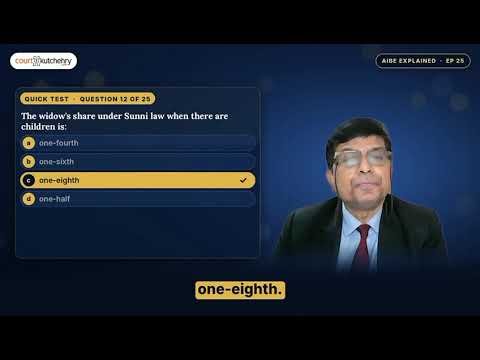
- Sunni widow’s share. Under Sunni (Hanafi) law, a widow takes one-fourth of the husband’s estate if there is no child, and one-eighth if there is a child or a son’s child.
- Section 25, Contract Act. An agreement without consideration is void, except a written and registered promise made out of natural love and affection, a promise to compensate for something done voluntarily, and a written promise to pay a time-barred debt.
- Section 128, Contract Act. The liability of the surety is co-extensive with that of the principal debtor, unless the contract provides otherwise.
Commercial Law, Property and Torts
- Section 138, NI Act. Dishonour of a cheque for insufficiency of funds is an offence. The payee must send a demand notice within 30 days of the bank’s return memo; the drawer then has 15 days to pay; and the complaint must be filed within one month after that period expires.
- Specific Relief Act, 2018 amendment. Specific performance of a contract is no longer discretionary. After the amendment, the court shall enforce specific performance, subject to the limited exceptions in the Act, and the party in breach can be made to bear the cost of substituted performance (Section 20).
- Section 53A, TPA. The doctrine of part performance protects a transferee who has taken possession under a written contract and is willing to perform his part. It is a shield to protect possession, not a sword to claim title.
- Rylands v. Fletcher (1868). A person who brings on his land something likely to do mischief if it escapes is liable for the damage it causes, even without negligence: the rule of strict liability. In India, the Supreme Court went further and laid down absolute liability for hazardous industries.
Arbitration, Labour, International and Administrative Law
- Award within 12 months. Under Section 29A of the Arbitration and Conciliation Act, 1996, as amended in 2019, a domestic award must be made within 12 months from the completion of pleadings. The parties may extend this by six months; any further extension needs the court.
- Strike notice. Under the Industrial Relations Code, 2020, which has been in force since 21 November 2025 with the other Labour Codes, no person employed in an industrial establishment may go on strike without giving 60 days’ notice, or within 14 days of giving that notice.
- International Court of Justice. The principal judicial organ of the United Nations, sitting at The Hague, with 15 judges elected for nine-year terms.
- Nemo judex in causa sua. No one should be a judge in his own cause: the rule against bias, one of the two pillars of natural justice. The other is audi alteram partem, hear the other side.
Ethics, Tax and IPR
- Bar Council of India. Constituted under Section 4 of the Advocates Act, 1961. It lays down standards of professional conduct and etiquette and the standards of legal education, and it conducts the AIBE.
- GST. Introduced by the Constitution (101st Amendment) Act, 2016. Article 246A gives Parliament and the States concurrent power to tax supplies, and Article 279A creates the GST Council.
- First GI. Darjeeling tea was the first product registered as a geographical indication in India.
Remember this line: if you can explain each of these 25 points in one sentence, you can answer the question the AIBE builds on it.
Three Tips for the Last Week
- Know your bare acts. Go through the bare acts chapter by chapter, so that you can find any provision in under a minute.
- Revise the landmark cases. Go back over the list of cases from this series. As the video notes, the Bar Council repeats them.
- Practise under the clock. Solve two full past papers under exam conditions, 100 questions in 210 minutes, and a third with the bare acts.
On the day, attempt every question. As the video says, there is no negative marking, so an unanswered question can only cost you.
Key Takeaways
- Episode 25 is a self-test: 25 questions, one from each area of the series. A score of 20 or more means you are ready.
- Many questions turn on a single number: 24 hours, 60/90 days, one year, 30 and 15 days, 12 months, 60 and 14 days.
- Know the new numbering: BNSS 58, 183 and 187; BNS 20 and 310; BSA 146.
- In the last week, revise bare acts and landmark cases and solve full papers under the clock.
- Attempt every question: there is no negative marking.
Frequently Asked Questions
How many questions are there in the AIBE and how much time is given?
The video works on 100 questions in 210 minutes. Always check the Bar Council of India’s notification for your exam.
Is there negative marking in the AIBE?
The video says there is none, so attempt every question.
Within how many days must a charge sheet be filed?
Within 60 or 90 days depending on the offence; otherwise the accused is entitled to default bail under BNSS Section 187 (old CrPC Section 167(2)).
Can a divorce petition be filed in the first year of marriage?
Not ordinarily. Section 14 of the Hindu Marriage Act requires one year, unless the court permits it for exceptional hardship or depravity.
How long does an arbitral tribunal have to make an award?
Twelve months from the completion of pleadings under Section 29A, extendable by six months by consent and further only by the court.
Where can I watch the video?
Watch the rapid-fire round in 11 minutes: https://youtu.be/gjkIvhCpe0s.
Conclusion
A rapid-fire round shows you exactly where you stand. If you scored 20 or more, spend the last week on bare acts, landmark cases and timed papers. If you scored less, go back to the episodes for the subjects where you slipped.
The video ends with the series’ good wishes to every candidate for the examination and for a long and honourable career at the Bar. Every judgment mentioned in the series is available in full text on CourtKutchehry.
▶ Watch the video: AIBE Rapid-Fire Revision: 25 Questions across All 19 Subjects + Last-Week Strategy | Ep 25
Research the Law on CourtKutchehry
CourtKutchehry gives you lakhs of Indian judgments, searchable for free. A membership adds unlimited summaries, all related judgments, original court PDF downloads, bookmarks, notes and the CourtKutchehry AI assistant.
| Membership | Price | Works out to | AI credits |
|---|---|---|---|
| Monthly (1 month) | ₹599 | ₹599 / month | 1,000 / month |
| Quarterly (3 months) · Save 16% | ₹1,499 | ₹499.67 / month | 1,100 / month |
| Six-monthly (6 months) · Save 33% | ₹2,399 | ₹399.83 / month | 1,200 / month |
| Yearly (12 months) · Save 44% · Best value | ₹3,999 | ₹333.25 / month | 1,300 / month |
Every plan is a one-off purchase for a fixed period: nothing auto-renews and no card is kept on file. Prices are exclusive of applicable tax, which is added at checkout. Extra AI chat credits can be topped up from ₹99. A free verified account gets 5 summaries and 50 AI trial credits.
Prices are as displayed on courtkutchehry.com on 20 November 2026 and are subject to change without notice. Please check the pricing page for the current plans and offers.
For more judgments, legal opinions and case analysis, visit courtkutchehry.com
Visit CourtKutchehry →