
Watch the Video
In this 9-minute video, Episode 40 and the final episode of the “AIBE Explained” series, the episode turns from the law in the paper to the paper itself: who is eligible, how to enrol and register, what to carry into the hall, how to fill the OMR sheet, and what happens after the result. It takes these in seven questions, from enrolment to the Certificate of Practice. This article sets out the same practical guide in writing, with the two Supreme Court judgments that shape it and the facts for the current session that we could confirm.
The Practical Side of the AIBE
These are the questions first-time candidates search for most, and getting one of them wrong can cost a whole sitting: a missed registration deadline, a highlighted bare act taken away at the door, or a roll number filled wrongly on the OMR sheet. None of these has anything to do with how well you know the law. The episode’s advice is simple: treat the procedure as seriously as the syllabus.
Q1: Who Is Eligible to Sit for the AIBE?
- A three-year or five-year LL.B. from a university recognised by the Bar Council of India, together with enrolment as an advocate with a State Bar Council under Section 24 of the Advocates Act, 1961.
- Final-year students who have cleared all previous semesters may also register. Their result is released only after proof of enrolment.
- There is no upper age limit and no limit on the number of attempts.
- From 2026 the examination is held twice a year. AIBE XXI was scheduled for 7 June 2026, and AIBE XXII is scheduled for 29 November 2026.
The legal basis is Bar Council of India v. Bonnie Foi Law College, (2023) 02 SC CK 0021, decided by a five-judge Constitution Bench on 10 February 2023. The Court upheld the Bar Council of India’s power to prescribe a qualifying examination, left it to the BCI to decide whether the AIBE is taken before or after enrolment, and allowed students who have cleared all examinations up to the final semester to take it.
Q2: How Do I Enrol with a State Bar Council?
Enrolment comes first, because the Certificate of Practice is linked to it. You apply to the State Bar Council of the State where you intend to practise, with your degree and mark sheets, proof of identity and age, and the other documents the Council asks for.
The enrolment fee: Gaurav Kumar (2024)
Until 2024, State Bar Councils charged very different amounts at enrolment, in some States running into tens of thousands of rupees once all the heads were added. In Gaurav Kumar v. Union of India, (2024) 07 SC CK 0054, decided on 30 July 2024, a Bench led by Chief Justice D.Y. Chandrachud held that State Bar Councils cannot charge more than the fee fixed by Section 24(1)(f) of the Advocates Act:
- ₹750 for general candidates (₹600 to the State Bar Council and ₹150 to the Bar Council of India); and
- ₹125 for SC and ST candidates (₹100 and ₹25).
Charges such as application, processing, verification and ID card fees are part of the enrolment fee and cannot be collected on top of it as a condition of enrolment; apart from the statutory fee, only applicable stamp duty can be charged. The judgment operates prospectively, so fees collected before it do not have to be refunded.
Remember this line: enrolment costs ₹750, or ₹125 for SC and ST candidates, all charges included.
Q3: How Do I Register for the Examination?
Registration is online at allindiabarexamination.com. You create an account, fill in your details, upload your photograph, signature and documents, choose your examination centre and language, and pay the fee online.
For AIBE XXII, the published fee was ₹3,500 for General and OBC candidates and ₹2,500 for SC and ST candidates, with bank charges added at payment. Registration closed on 27 October 2026 and admit cards were released from 14 November 2026. Each session has its own notification and deadlines, so always check the latest one before you act.
Q4: What to Carry into the Hall, and What Is Not Allowed
Carry
- A printed admit card;
- An original photo identity document;
- A black or blue ballpoint pen; and
- Plain bare acts, without notes or annotations.
Not allowed
- Notes, written tabs, mobile phones, smart watches and bags.
- The episode notes that recent sessions have also banned highlighting and underlining in bare acts, so do not mark the copies you plan to carry.
Prepare with the same unmarked bare acts you will take into the hall. If your preparation copies are heavily highlighted, buy a clean set early and practise with it, so that you know where each chapter is without the colour.
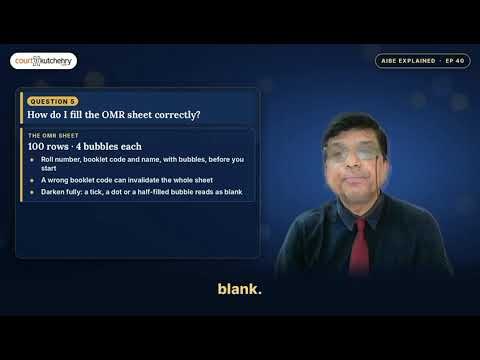
Q5: How to Fill the OMR Sheet Correctly
- Fill in the roll number and booklet code first, before you read a single question. A mistake here can invalidate the whole sheet.
- Darken each bubble fully with the pen; a tick or a half-filled circle may not be read.
- Do not erase or overwrite; there is no correction.
- Attempt every question. There is no negative marking, so a blank answer can only cost you.
The paper has 100 multiple-choice questions in three hours and thirty minutes. Leave the last ten minutes to check that every question has one answer marked against the right number.
Q6: What Happens After the Examination?
- A provisional answer key is published and candidates can raise objections within the stated window.
- The final answer key and the result follow. The result is simply pass or fail; there is no rank.
- The qualifying mark is 45% for General and OBC candidates and 40% for SC, ST and PwD candidates.
- On passing, the Certificate of Practice is issued through the State Bar Council. The episode explains that it is to be renewed every five years under the BCI’s 2015 Verification Rules.
Q7: Last Advice
The episode closes with practical advice: register early, read the notification for your session in full, keep your enrolment papers ready, prepare with clean bare acts, and practise finding sections by chapter heading. And it closes the series itself: forty episodes, every subject in the syllabus, a full 100-question mock test, and the procedure from enrolment to certificate.
Key Takeaways
- You need an LL.B. from a BCI-recognised university and enrolment under Section 24; final-year students who have cleared earlier semesters may also sit.
- Gaurav Kumar (2024) caps the enrolment fee at ₹750 (general) and ₹125 (SC/ST), all charges included.
- Bonnie Foi (2023) upheld the BCI’s power to hold the examination and allowed final-semester students to take it.
- Carry an admit card, photo ID, a ballpoint pen and plain, unmarked bare acts; no phones, notes or highlighting.
- No negative marking: fill the roll number first, darken bubbles fully and attempt every question.
Frequently Asked Questions
Can a final-year law student take the AIBE?
Yes, if he or she has cleared all previous semesters. The result is released only after proof of enrolment with a State Bar Council.
How much can a State Bar Council charge for enrolment?
After Gaurav Kumar v. Union of India (2024), no more than ₹750 for general candidates and ₹125 for SC and ST candidates, as fixed by Section 24(1)(f) of the Advocates Act.
Is there a limit on attempts or an upper age limit?
No. There is no upper age limit and no limit on the number of attempts.
Is there negative marking in the AIBE?
No. Every correct answer earns one mark and a wrong answer costs nothing, so attempt every question.
Can I highlight my bare acts?
Recent sessions have banned highlighting and underlining. Carry plain, unannotated bare acts, and check the hall rules in the notification for your session.
Where can I watch the video?
Watch the final episode of AIBE Explained here: https://youtu.be/7OLLFjmHFYI.
Conclusion
The AIBE tests the law, but it is lost as often on procedure: a missed deadline, a marked bare act, an OMR sheet filled carelessly. Enrol first, register early, check the notification for your session, prepare with the bare acts you will carry, and attempt every question.
Dates, fees and hall rules change from session to session, so check the latest notification on allindiabarexamination.com before you act. We wish every candidate success in the examination and a long and honourable career at the Bar.
▶ Watch the video: AIBE Practical Guide: Eligibility, Enrolment Fee (Gaurav Kumar), Registration Ep 40
📖 Read more: Supreme Court Allows Final-Year Law Students to Take AIBE Twice a Year: Major Relief for Aspiring Lawyers
Research Judgments Like These on CourtKutchehry
Every judgment cited in this article, and lakhs more, can be searched and read on CourtKutchehry. Searching and reading judgments is free. A membership adds unlimited summaries, all related judgments, original court PDF downloads, bookmarks, notes and the CourtKutchehry AI assistant.
| Membership | Price | Works out to | AI credits |
|---|---|---|---|
| Monthly (1 month) | ₹599 | ₹599 / month | 1,000 / month |
| Quarterly (3 months) · Save 16% | ₹1,499 | ₹499.67 / month | 1,100 / month |
| Six-monthly (6 months) · Save 33% | ₹2,399 | ₹399.83 / month | 1,200 / month |
| Yearly (12 months) · Save 44% · Best value | ₹3,999 | ₹333.25 / month | 1,300 / month |
Every plan is a one-off purchase for a fixed period: nothing auto-renews and no card is kept on file. Prices are exclusive of applicable tax, which is added at checkout. Extra AI chat credits can be topped up from ₹99. A free verified account gets 5 summaries and 50 AI trial credits.
Prices are as displayed on courtkutchehry.com on 20 November 2026 and are subject to change without notice. Please check the pricing page for the current plans and offers.
For more judgments, legal opinions and case analysis, visit courtkutchehry.com
Visit CourtKutchehry →