
Watch the Video
In this 12-minute video, Episode 20 of the “AIBE Explained” series, the episode explains Labour and Industrial Law in six questions: industry and workman; strike, lock-out, lay-off and retrenchment; the dispute machinery; trade unions; wages and gratuity; and the Factories Act, now the OSH Code. For each concept he gives the old provision and what the new Labour Code has changed, and then solves five practice questions in the style of past AIBE papers. This article sets out the same material in writing.
▶ Watch on YouTube: Labour & Industrial Law for AIBE: Industry, Workman, Retrenchment, Strikes Ep 20
A Word of Caution: The Old Acts and the New Codes
Labour and Industrial Law carries 4 marks in the AIBE. As the video explains, the four Labour Codes came into force on 21 November 2025, replacing 29 central labour laws, including the Industrial Disputes Act, 1947, the Factories Act, 1948 and the Payment of Gratuity Act, 1972:
- the Code on Wages, 2019;
- the Industrial Relations Code, 2020;
- the Code on Social Security, 2020; and
- the Occupational Safety, Health and Working Conditions Code, 2020 (OSH Code).
The AIBE syllabus and past papers were built on the old Acts, but the concepts remain the same. So the safe approach is to learn each concept, its old section and the change made by the Code.
Q1. What Is an Industry and Who Is a Workman?
The leading case on “industry” is the seven-judge bench decision in Bangalore Water Supply and Sewerage Board v. A. Rajappa (1978). It laid down the triple test: where there is (i) a systematic activity, (ii) organised by co-operation between employer and employees, (iii) for the production or distribution of goods or services to satisfy human wants (not spiritual or religious ones), the activity is an industry, whatever the motive and whether or not it makes a profit.
Under the old law, a workman was defined in Section 2(s) of the Industrial Disputes Act. The Industrial Relations Code now uses the term “worker”. Persons employed in a supervisory capacity are excluded if they draw wages above ₹18,000 a month under the IR Code; the old limit was ₹10,000. What matters is the nature of the main work done, not the designation.
Q2. Strike, Lock-out, Lay-off and Retrenchment
Strike and lock-out
Under the old Act, notice of strike or lock-out was required only in public utility services. Under the IR Code, 14 days’ notice is required in every industrial establishment, and the strike or lock-out must take place within 60 days of the notice.
Lay-off
A laid-off worker is entitled to compensation equal to 50% of the total of basic wages and dearness allowance for the period of lay-off.
Retrenchment
Retrenchment means termination of service for any reason other than those excluded by the definition (such as punishment by disciplinary action, voluntary retirement, superannuation and non-renewal of a fixed-term contract). In State Bank of India v. N. Sundara Money, (1976) 01 SC CK 0013, the Supreme Court gave the term a wide meaning, covering termination “for any reason whatsoever” outside the exclusions.
The conditions for a valid retrenchment remain: one month’s notice in writing (or wages in lieu), and compensation of 15 days’ average pay for every completed year of continuous service.
For larger establishments, prior government permission is needed for lay-off, retrenchment or closure. The threshold under the IR Code is 300 workers; under the old Act it was 100.
Remember this line: the concept stays the same; the numbers change: ₹18,000, 14 days, 300 workers.
Q3. The Dispute Resolution Machinery
The old Act had a layered system of Works Committees, conciliation officers, Boards of Conciliation, Courts of Inquiry, Labour Courts, Industrial Tribunals and National Tribunals.
The IR Code simplifies this. It abolishes separate Labour Courts and retains Industrial Tribunals and a National Industrial Tribunal. Conciliation continues, and if conciliation fails, the parties can approach the tribunal directly, without waiting for a government reference.
Q4. Trade Unions
Trade unions were registered under the Trade Unions Act, 1926, now subsumed in the IR Code. The Code introduces the concept of a negotiating union: where there is only one registered trade union in an establishment, it is recognised as the sole negotiating union, and where there are several, the union with at least 51% of the workers as members is recognised. Otherwise a negotiating council is formed.
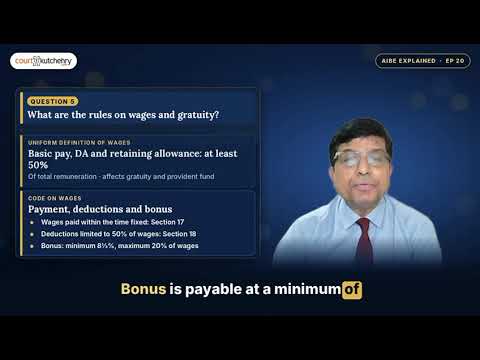
Q5. Wages and Gratuity
Code on Wages, 2019
- The Central Government fixes a national floor wage (Section 9), and no State minimum wage can be below it.
- The definition of “wages” has a 50% rule: if the excluded allowances exceed half of the total remuneration, the excess is added back to wages. In practice, basic pay and dearness allowance should be at least 50% of total pay.
Code on Social Security, 2020
- Gratuity is payable after five years of continuous service at 15 days’ wages for every completed year, and for fixed-term employees after one year.
- Maternity benefit is 26 weeks.
- Social security is extended to gig workers and platform workers.
Q6. The Factories Act, Now the OSH Code
- The definition of factory now covers premises with 20 or more workers where the process uses power, and 40 or more without power (the old limits were 10 and 20).
- Women may work night shifts with their consent, subject to conditions on safety and working hours.
- The contract labour threshold has been raised from 20 to 50 workers.
On contract labour, a Constitution Bench in Steel Authority of India Ltd. v. National Union Water Front Workers, (2001) 08 SC CK 0146 held that abolition of contract labour under the old Contract Labour Act does not result in automatic absorption of the contract workers by the principal employer.
Key Takeaways
- The four Labour Codes are in force from 21 November 2025 and replace 29 central laws, but the concepts in past AIBE papers continue.
- Industry: the triple test of Bangalore Water Supply (1978); “workman” is now “worker”, with supervisors above ₹18,000 excluded.
- Strike or lock-out: 14 days’ notice in every industrial establishment, valid for 60 days; lay-off compensation 50%.
- Retrenchment: one month’s notice and 15 days’ average pay per completed year; government permission threshold now 300 workers.
- Gratuity after five years (one year for fixed-term employees); maternity benefit 26 weeks; factory thresholds 20 and 40; contract labour threshold 50.
Frequently Asked Questions
Is the Industrial Disputes Act still in force?
No. It has been replaced by the Industrial Relations Code, 2020, in force from 21 November 2025, but its concepts are carried forward.
What is the triple test for an industry?
A systematic activity, organised by co-operation between employer and employees, for producing or distributing goods or services to satisfy human wants, as laid down in Bangalore Water Supply (1978).
How much retrenchment compensation is payable?
Fifteen days’ average pay for every completed year of continuous service, along with one month’s notice or wages in lieu.
When does a fixed-term employee become entitled to gratuity?
After one year of service under the Code on Social Security, 2020, instead of the usual five years.
Are contract workers automatically absorbed when contract labour is abolished?
No. The Constitution Bench in Steel Authority of India (2001) rejected automatic absorption.
Where can I watch the full explanation?
Watch the full explanation in 12 minutes: https://youtu.be/YZ3XMn6hzQE.
Conclusion
Labour law is in transition. The old Acts are gone, but the questions the AIBE asks about industry, workman, strike, retrenchment, wages and gratuity rest on concepts that the Codes have kept, with new numbers.
Learn each concept with the old provision and the new figure, and the 4 marks in this subject become manageable. The next episode takes up Public International Law and Administrative Law.
▶ Watch the video: Labour & Industrial Law for AIBE: Industry, Workman, Retrenchment, Strikes Ep 20
📖 Read more: Supreme Court Clarifies: Designation Alone Doesn’t Decide Who Qualifies as ‘Workman’ Under Industrial Disputes Act
Research Judgments Like These on CourtKutchehry
Every judgment cited in this article, and lakhs more, can be searched and read on CourtKutchehry. Searching and reading judgments is free. A membership adds unlimited summaries, all related judgments, original court PDF downloads, bookmarks, notes and the CourtKutchehry AI assistant.
| Membership | Price | Works out to | AI credits |
|---|---|---|---|
| Monthly (1 month) | ₹599 | ₹599 / month | 1,000 / month |
| Quarterly (3 months) · Save 16% | ₹1,499 | ₹499.67 / month | 1,100 / month |
| Six-monthly (6 months) · Save 33% | ₹2,399 | ₹399.83 / month | 1,200 / month |
| Yearly (12 months) · Save 44% · Best value | ₹3,999 | ₹333.25 / month | 1,300 / month |
Every plan is a one-off purchase for a fixed period: nothing auto-renews and no card is kept on file. Prices are exclusive of applicable tax, which is added at checkout. Extra AI chat credits can be topped up from ₹99. A free verified account gets 5 summaries and 50 AI trial credits.
Prices are as displayed on courtkutchehry.com on 20 November 2026 and are subject to change without notice. Please check the pricing page for the current plans and offers.
For more judgments, legal opinions and case analysis, visit courtkutchehry.com
Visit CourtKutchehry →