
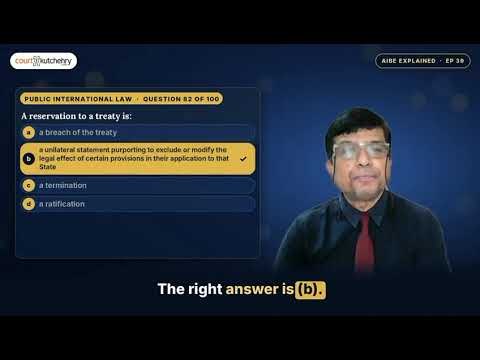
Watch the Video
In this 17-minute video, Episode 39 of the “AIBE Explained” series, the episode completes the 100-question AIBE mock paper. Mock Test Part 3 solves Questions 68 to 100, covering every remaining subject from Torts and Arbitration to Professional Ethics, Tax and IPR, and then shows how to work out your result. The questions are best taken in the video, under exam conditions. This article explains the law behind the topics tested and the scoring guidance given at the end.
Mock Test Part 3: Many Subjects, Few Questions Each
This is the last part of the three-part mock test, after Mock Test Part 1 (Questions 1 to 34) and Mock Test Part 2 (Questions 35 to 67). Give yourself 70 minutes, pause after each question, and mark your answer before you hear the explanation. Here eight subject groups share 33 questions, and each question usually tests one well-known rule, case or number.
Torts, Motor Vehicles and Consumer Protection: Questions 68 to 72
- Medical negligence and the Bolam test: a doctor is not negligent if he acted in accordance with a practice accepted as proper by a responsible body of medical opinion. In Jacob Mathew v. State of Punjab, (2005) 08 SC CK 0074, the Supreme Court applied this test and held that, for criminal liability, the negligence must be gross.
- Strict liability: the rule in Rylands v. Fletcher: a person who brings onto his land something likely to do mischief if it escapes is liable for the damage caused by its escape, subject to recognised exceptions. Indian law has gone further with absolute liability for hazardous industries, which admits no such exceptions.
- Six months for motor accident claims: since the 2019 amendment, Section 166(3) of the Motor Vehicles Act, 1988 says a claim for compensation shall not be entertained unless it is made within six months of the accident.
- Pranay Sethi: in National Insurance Company Ltd. v. Pranay Sethi, (2017) 10 SC CK 0044, a Constitution Bench fixed the addition for future prospects (for example, 50% for a permanently employed victim below 40, and 40% for a self-employed one below 40) and the conventional heads: ₹15,000 for loss of estate, ₹40,000 for loss of consortium and ₹15,000 for funeral expenses, to be increased by 10% every three years.
- Two years for consumer complaints: under Section 69 of the Consumer Protection Act, 2019, a complaint must be filed within two years from the date the cause of action arose, unless delay is condoned for sufficient cause.
Arbitration: Questions 73 to 76
- Written agreement (Section 7): an arbitration agreement must be in writing, which includes an exchange of letters, emails or other electronic communications, or a statement of claim and defence where one party alleges it and the other does not deny it.
- Reference under Section 8: a judicial authority must refer the parties to arbitration if a party applies no later than the date of submitting his first statement on the substance of the dispute, unless it finds that prima facie no valid arbitration agreement exists.
- No automatic stay (Section 36): since the 2015 amendment, merely filing a Section 34 petition to set aside an award does not stay its enforcement; the court must grant a stay on a separate application.
- The 120-day mediation limit: under Section 18 of the Mediation Act, 2023, mediation is to be completed within 120 days from the parties’ first appearance before the mediator, extendable by up to 60 days with the parties’ consent.
Labour Law: Questions 77 to 80
The four Labour Codes have now replaced the older labour statutes, so answer in their terms. The Code on Wages, 2019 brings together the law on payment of wages, minimum wages, bonus and equal remuneration. Lay-off compensation is 50% of the basic wages and dearness allowance the worker would have received.
On contract labour absorption, a Constitution Bench in Steel Authority of India Ltd. v. National Union Water Front Workers, (2001) 08 SC CK 0146, held that a notification abolishing contract labour does not lead to automatic absorption of the contract workers by the principal employer.
Maternity leave is 26 weeks, the entitlement since the 2017 amendment to the Maternity Benefit Act, now carried into the Code on Social Security, 2020.
Public International Law: Questions 81 to 84
- The ICJ: the principal judicial organ of the UN, at The Hague, with 15 judges elected for nine years. Only States can be parties to contentious cases.
- Treaty reservations: a unilateral statement by which a State seeks to exclude or modify the legal effect of certain provisions of a treaty for itself. Under the Vienna Convention on the Law of Treaties, 1969, a reservation is not permitted if the treaty forbids it or if it is incompatible with the object and purpose of the treaty.
- The 200-nautical-mile EEZ: the Exclusive Economic Zone extends up to 200 nautical miles from the baselines (UNCLOS). The territorial sea is 12 nautical miles and the contiguous zone 24.
- Dualism: international law and municipal law are separate systems, and a treaty becomes enforceable domestically only through legislation. India follows this approach, with Article 253 giving Parliament power to legislate to implement treaties.
Professional Ethics: Questions 85 to 88
This block tests Rules 34, 36 and 49 of the Bar Council of India Rules and the disciplinary powers under Section 35 of the Advocates Act, 1961. Two of these rules are asked again and again. Rule 36 forbids an advocate from soliciting work or advertising, directly or indirectly. Rule 49 forbids an advocate from being a full-time salaried employee of any person, government, firm or corporation while practising.
Under Section 35, if the disciplinary committee of a State Bar Council finds an advocate guilty of professional or other misconduct, it may reprimand him, suspend him from practice, or remove his name from the State roll; it may also dismiss the complaint. An appeal lies to the Bar Council of India and then to the Supreme Court.
Remember this line: for an advocate, advertising and full-time employment are both off limits.
Tax Law and Company Law: Questions 89 to 94
- Agricultural income: the Union cannot tax it; the power belongs to the States under the State List, and it is exempt from central income tax.
- Appeals from the ITAT: lie to the High Court, only on a substantial question of law.
- IGST: levied and collected by the Union on inter-State supplies and imports, under Article 269A.
- The GST Council: constituted under Article 279A, chaired by the Union Finance Minister.
- Minimum directors (Section 149, Companies Act, 2013): three for a public company, two for a private company and one for a One Person Company.
- The memorandum of association (Section 4): the company’s charter, including its name, registered office State and objects. An act outside the objects is ultra vires and void.
Administrative Law, Environment, Cyber, Property and IPR: Questions 95 to 100
Administrative law (Questions 95 and 96)
In the GCHQ case (Council of Civil Service Unions v. Minister for the Civil Service, House of Lords, 1985), Lord Diplock classified the grounds of judicial review as illegality, irrationality and procedural impropriety. In L. Chandra Kumar v. Union of India, (1997) 03 SC CK 0098, a seven-judge bench held that the power of judicial review of the High Courts under Articles 226 and 227 and of the Supreme Court under Article 32 is part of the basic structure, so decisions of tribunals are subject to scrutiny by a Division Bench of the High Court.
Environment, cyber, property and IPR (Questions 97 to 100)
- The Environment (Protection) Act, 1986 was enacted under Article 253, to implement the decisions of the 1972 Stockholm Conference.
- Cyber terrorism is punishable under Section 66F of the Information Technology Act, 2000, with imprisonment which may extend to life.
- Mortgage by conditional sale (Section 58(c), TPA): an ostensible sale on condition that it becomes void on payment, or absolute on default. It is a mortgage only if the condition is in the sale document itself.
- Darjeeling tea was the first product registered as a Geographical Indication in India.
How to Work Out Your Result
The episode ends with the scoring. Add your three scores: Part 1 (out of 34), Part 2 (out of 33) and Part 3 (out of 33).
- Qualifying marks: 45 for General and OBC candidates, 40 for SC, ST and PwD candidates.
- 55 or more: comfortably ready; revise your weak subjects and keep solving papers.
- Just around the qualifying mark: go back to the episodes on the subjects where you lost marks.
- Ran out of time: practise finding sections in the bare act by chapter heading.
Key Takeaways
- Part 3 has 33 questions across eight subject groups; take it in 70 minutes and add it to your scores from Parts 1 and 2.
- Know the limits: six months for motor accident claims, two years for consumer complaints, 120 days for mediation.
- Know the leading cases: Jacob Mathew (Bolam test), Pranay Sethi (future prospects), SAIL (no automatic absorption), L. Chandra Kumar (judicial review is basic structure).
- Rules 36 and 49 of the BCI Rules (no advertising, no full-time employment) and Section 35 of the Advocates Act are favourites.
- The qualifying mark is 45 (General and OBC) or 40 (SC, ST and PwD) out of 100.
Frequently Asked Questions
What is the time limit for a motor accident claim?
Six months from the accident, under Section 166(3) of the Motor Vehicles Act as amended in 2019.
Does filing a Section 34 petition stay an arbitral award?
No. Since the 2015 amendment, there is no automatic stay; the court must grant a stay on a separate application under Section 36.
What score do I need to pass the AIBE?
As the episode explains, 45 out of 100 for General and OBC candidates, and 40 for SC, ST and PwD candidates.
What are the other parts of the mock test?
Mock Test Part 1 (Questions 1 to 34: Constitution, BNSS, CPC and Limitation) and Mock Test Part 2 (Questions 35 to 67: BNS, BSA, Family Law, Contract and Property).
Where can I watch the video?
Take Part 3 of the mock test here: https://youtu.be/XP8Dpqyhqp4.
Conclusion
Part 3 is where many candidates lose easy marks: the subjects are many and each has only a few questions. One rule, case or number per topic is usually enough.
Add your three scores, compare them with the qualifying mark, and spend your remaining preparation time on the subjects where you lost marks. The next and final episode of the series covers the practical side of the AIBE, from enrolment to the Certificate of Practice.
▶ Watch the video: AIBE Full Mock Test Part 3: Questions 68 to 100 + How to Work Out Your Score | AIBE Explained Ep 39
Research Judgments Like These on CourtKutchehry
Every judgment cited in this article, and lakhs more, can be searched and read on CourtKutchehry. Searching and reading judgments is free. A membership adds unlimited summaries, all related judgments, original court PDF downloads, bookmarks, notes and the CourtKutchehry AI assistant.
| Membership | Price | Works out to | AI credits |
|---|---|---|---|
| Monthly (1 month) | ₹599 | ₹599 / month | 1,000 / month |
| Quarterly (3 months) · Save 16% | ₹1,499 | ₹499.67 / month | 1,100 / month |
| Six-monthly (6 months) · Save 33% | ₹2,399 | ₹399.83 / month | 1,200 / month |
| Yearly (12 months) · Save 44% · Best value | ₹3,999 | ₹333.25 / month | 1,300 / month |
Every plan is a one-off purchase for a fixed period: nothing auto-renews and no card is kept on file. Prices are exclusive of applicable tax, which is added at checkout. Extra AI chat credits can be topped up from ₹99. A free verified account gets 5 summaries and 50 AI trial credits.
Prices are as displayed on courtkutchehry.com on 20 November 2026 and are subject to change without notice. Please check the pricing page for the current plans and offers.
For more judgments, legal opinions and case analysis, visit courtkutchehry.com
Visit CourtKutchehry →