
Watch the Video
In this 15-minute video, Episode 38 of the “AIBE Explained” series, the episode continues the complete 100-question AIBE mock paper. Mock Test Part 2 solves Questions 35 to 67: eight each from the Penal Code (BNS), Evidence (BSA), Family Law, and Contract with Specific Relief and the Negotiable Instruments Act, plus one from Property law. The questions are best taken in the video, under exam conditions. This article explains the law behind the topics that this part tests and how to approach each kind of question, so you can revise before the mock or check your answers after it.
Mock Test Part 2: How to Take It
This is the middle part of a three-part mock test. Mock Test Part 1 (Questions 1 to 34) covered Constitutional Law, the BNSS, the CPC and Limitation; Mock Test Part 3 (Questions 68 to 100) covers the remaining subjects and how to work out your result. As before, pause after each question, mark your answer, then listen to the explanation. Give yourself 70 minutes, and add today’s score to your score from Part 1.
The criminal-law questions in this part use the new codes: the Bharatiya Nyaya Sanhita, 2023 (BNS) and the Bharatiya Sakshya Adhiniyam, 2023 (BSA), in force from 1 July 2024. If you learnt the IPC and the Evidence Act, keep a conversion table of the main sections beside you.
Penal Code (BNS): Questions 35 to 42
- Consent in good faith (Section 26): an act not intended to cause death, done in good faith for a person’s benefit with his consent, is not an offence because of any harm it may cause (old Section 88 IPC).
- Common intention (Section 3(5)): when a criminal act is done by several persons in furtherance of the common intention of all, each is liable as if he had done it alone (old Section 34).
- Petty theft and community service (Section 303(2)): for a first conviction where the stolen property is worth less than ₹5,000 and is returned or restored, the punishment can be community service, one of the new punishments under the BNS.
- Dishonest misappropriation (Section 314): dishonestly misappropriating or converting movable property to one’s own use (old Section 403). The property came into the accused’s hands innocently; the dishonesty comes later.
- Grave and sudden provocation: Exception 1 to murder in Section 101. Culpable homicide is not murder if the offender, deprived of self-control by grave and sudden provocation, causes the death of the person who gave it. The provocation must not be sought out or voluntarily provoked.
- Snatching (Section 304): a new offence under the BNS, where the offender suddenly or quickly or forcibly seizes or grabs movable property from a person.
- Cheating (Section 318): deceiving a person and dishonestly or fraudulently inducing him to deliver property or do something he would not otherwise do (old Sections 415 to 420).
- Child below seven (Section 20): nothing done by a child under seven years is an offence (old Section 82).
Evidence (BSA): Questions 43 to 50
- “Not proved” (Section 2(1)(i)): a fact is not proved when it is neither proved nor disproved. Learn it alongside “proved” and “disproved”.
- Absence of consent in rape: in a prosecution for rape where sexual intercourse is proved and the woman states in her evidence that she did not consent, the court shall presume that she did not consent (Section 120 BSA, old Section 114A).
- Spousal privilege (Section 128): a married person cannot be compelled to disclose, and is not permitted to disclose without consent, any communication made during the marriage by the other spouse, except in suits between them or prosecutions of one for an offence against the other.
- Entries in public registers (Section 29): an entry in a public or official register made by a public servant in the discharge of official duty is a relevant fact.
- Public documents (Section 74): documents forming the acts or records of sovereign authorities, official bodies, tribunals and public officers. All other documents are private.
- Insulting questions (Section 155): the court shall forbid questions that appear to it to be intended to insult or annoy, or which, though proper in themselves, appear needlessly offensive in form.
- Standard of proof: beyond reasonable doubt in criminal cases; preponderance of probabilities in civil cases.
- Previous judgments (Section 34): an earlier judgment is relevant where the law prevents a court from taking cognizance of a suit or holding a trial, such as under res judicata or double jeopardy.
Family Law: Questions 51 to 58
- Sapinda marriages: under the Hindu Marriage Act, 1955, sapinda relationship extends to three generations in the line of ascent through the mother and five through the father (Section 3(f)). A marriage between sapindas is void unless a custom governing both parties permits it.
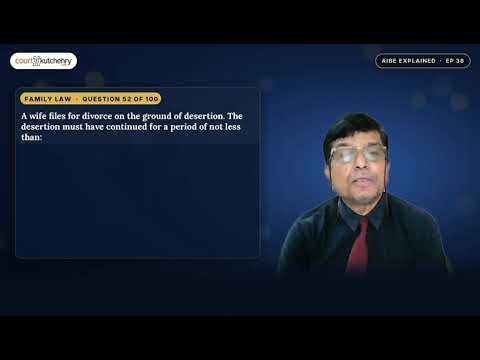
- Desertion: a ground for divorce where the other spouse has deserted the petitioner for a continuous period of not less than two years immediately before the petition (Section 13(1)(ib)).
- Female intestate succession (Section 15(2), Hindu Succession Act, 1956): if a Hindu woman dies without a son or daughter (or children of a predeceased son or daughter), property she inherited from her father or mother goes to the heirs of her father, and property inherited from her husband or father-in-law goes to the heirs of her husband.
- Gift to take effect after death: a gift transfers existing property during the donor’s lifetime. A disposition that is to operate only on death is testamentary in nature, and stands or falls as a will.
- Triple talaq: set aside by the Supreme Court in 2017 in Shayara Bano v. Union of India; the Muslim Women (Protection of Rights on Marriage) Act, 2019 declares it void and makes it an offence punishable with up to three years’ imprisonment and fine.
- Adoption when a son is living: under Section 11(i) of the Hindu Adoptions and Maintenance Act, 1956, a person adopting a son must not have a Hindu son, son’s son or son’s son’s son living at the time.
- The Special Marriage Act, 1954: a civil marriage open to any two persons regardless of religion; the bride must be 18 and the groom 21, notice is given to the Marriage Officer, and objections can be raised within 30 days of publication.
- Appointment of guardians (Section 19, Guardians and Wards Act, 1890): the court cannot appoint a guardian of the person of a minor whose father is living and is not, in the opinion of the court, unfit.
Contract, Specific Relief and NI Act: Questions 59 to 66
- Frustration (Section 56, Contract Act): a contract to do an act which, after it is made, becomes impossible or unlawful, becomes void.
- Contingent contracts (Section 31): a contract to do or not to do something if an event collateral to it does or does not happen.
- Damages (Section 73): compensation for loss that naturally arose in the usual course of things, or that the parties knew when they made the contract to be likely; not for remote and indirect loss.
- Delegatus non potest delegare (Section 190): an agent cannot lawfully employ another to perform acts he has expressly or impliedly undertaken to perform personally, unless custom or the nature of the agency allows it.
- Substituted performance (Section 20, Specific Relief Act, 1963): introduced in 2018; the party suffering a breach may get the contract performed by a third party or its own agency and recover the cost from the party in breach, after giving 30 days’ written notice.
- Declaration without consequential relief (Section 34): a court will not make a mere declaration where the plaintiff, being able to seek further relief, omits to do so.
- Stale cheques: under RBI directions, a cheque is valid for three months from its date; a cheque presented after that is stale, and no Section 138 complaint arises on its dishonour.
- Holder in due course (Section 9, NI Act): a person who takes a negotiable instrument for consideration, before it is due, and without sufficient cause to believe there was any defect in the title of the person from whom he took it.
Remember this line: frustration makes a contract void; it does not make it voidable.
Property: Question 67
Section 13 of the Transfer of Property Act, 1882 deals with a transfer for the benefit of an unborn person. Property cannot be transferred directly to a person not yet born. It can be done only by first creating a prior interest in favour of a living person (usually a life interest), and the interest given to the unborn person must extend to the whole of the remaining interest of the transferor in the property. A transfer giving the unborn person only a life interest fails.
Add Your Score
Note your score out of 33 for this part and add it to your Part 1 score out of 34. Mock Test Part 3, the final part, covers Questions 68 to 100 and then shows how to work out your result.
Key Takeaways
- Part 2 has 33 questions in 70 minutes, across the BNS, the BSA, Family Law, Contract and allied Acts, and Property.
- Know the new BNS provisions: community service for petty theft (Section 303(2)) and snatching (Section 304).
- BSA numbers matter: Section 120 (presumption in rape), 128 (spousal privilege), 74 (public documents).
- Family law turns on fixed rules: sapinda limits of three and five generations, two years of desertion, and Section 15(2) HSA.
- A transfer to an unborn person needs a prior interest and must give the whole remaining interest (Section 13 TPA).
Frequently Asked Questions
How many questions are in Mock Test Part 2?
Thirty-three: eight each from the BNS, the BSA, Family Law and Contract with Specific Relief and the NI Act, and one from Property law.
Can a court order community service for theft?
Yes. Under Section 303(2) of the BNS, for a first conviction where the stolen property is worth less than ₹5,000 and is returned or restored, the offender can be punished with community service.
Is a sapinda marriage void or voidable?
Void, unless a custom or usage governing each of the parties permits it.
What is substituted performance?
Under Section 20 of the Specific Relief Act, the party suffering a breach can have the contract performed by someone else and recover the cost from the party in breach, after giving 30 days’ notice.
What are the other parts of the mock test?
Mock Test Part 1 (Questions 1 to 34) and Mock Test Part 3 (Questions 68 to 100, with how to work out your final result).
Where can I watch the video?
Take Part 2 of the mock test here: https://youtu.be/wjtC9NA5PVk.
Conclusion
Part 2 tests the subjects where the AIBE changed most after 1 July 2024: the BNS and the BSA. Many candidates still think in IPC and Evidence Act numbers, and the options are often built around exactly that confusion. Learn the new numbers with the old ones beside them.
Family law, contract and property questions reward precise rules: two years, three and five generations, 30 days, three months. Add your score to Part 1 and move on to Mock Test Part 3.
▶ Watch the video: AIBE Full Mock Test Part 2: Questions 35 to 67, BNS, BSA (Evidence), Family Law Ep 38
Research Judgments Like These on CourtKutchehry
Every judgment cited in this article, and lakhs more, can be searched and read on CourtKutchehry. Searching and reading judgments is free. A membership adds unlimited summaries, all related judgments, original court PDF downloads, bookmarks, notes and the CourtKutchehry AI assistant.
| Membership | Price | Works out to | AI credits |
|---|---|---|---|
| Monthly (1 month) | ₹599 | ₹599 / month | 1,000 / month |
| Quarterly (3 months) · Save 16% | ₹1,499 | ₹499.67 / month | 1,100 / month |
| Six-monthly (6 months) · Save 33% | ₹2,399 | ₹399.83 / month | 1,200 / month |
| Yearly (12 months) · Save 44% · Best value | ₹3,999 | ₹333.25 / month | 1,300 / month |
Every plan is a one-off purchase for a fixed period: nothing auto-renews and no card is kept on file. Prices are exclusive of applicable tax, which is added at checkout. Extra AI chat credits can be topped up from ₹99. A free verified account gets 5 summaries and 50 AI trial credits.
Prices are as displayed on courtkutchehry.com on 20 November 2026 and are subject to change without notice. Please check the pricing page for the current plans and offers.
For more judgments, legal opinions and case analysis, visit courtkutchehry.com
Visit CourtKutchehry →