
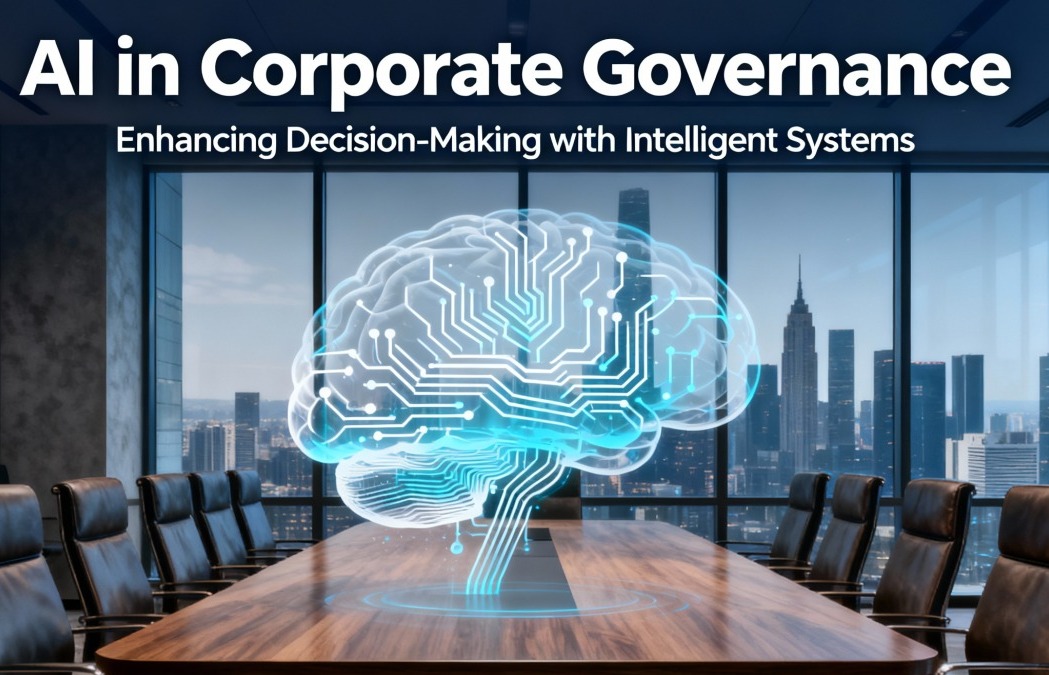
Boardrooms and Algorithms: AI in Corporate Governance
Algorithmic Accountability in Decision-Making
Shareholder Rights in Digital Corporations
By Vishwas Kumar
New Delhi: June 13, 2026:
Corporate governance has always been about accountability, transparency, and fairness in decision-making. Traditionally, boards relied on human judgment, financial reports, and regulatory frameworks to guide their actions. Today, Artificial Intelligence (AI) is entering the boardroom, reshaping how corporations assess risks, manage compliance, and interact with shareholders. By 2030, AI will not only streamline governance processes but also redefine the legal, constitutional, and ethical foundations of corporate accountability.
The constitutional dimensions are striking. Article 14, which guarantees equality before law, now extends to algorithmic fairness in governance. If AI systems disproportionately favor majority shareholders or exclude minority voices, they risk violating this principle. Article 19(1)(c) protects the right to form associations, ensuring that shareholder democracy remains intact even in digital corporations. Article 21, expanded by the Puttaswamy judgment, enshrines privacy, making the protection of corporate and personal data a constitutional necessity.
Statutory frameworks are evolving to meet these challenges. The Companies Act, 2013, mandates fiduciary duties and accountability for directors, which now extend to oversight of AI systems. SEBI guidelines require transparency in AI-driven trading and disclosures, while the DPDP Act, 2023, regulates personal and corporate data used in governance. The IT Act, 2000, provides cybersecurity safeguards, ensuring that AI systems do not compromise corporate integrity. Judicial precedents such as TCS v. Cyrus Mistry reinforce board accountability, while Shreya Singhal emphasizes clarity in digital regulation.
Globally, India’s trajectory mirrors broader trends. The EU’s AI Act adopts a risk-based approach, the US emphasizes disclosure under SEC rules, China enforces state-centric compliance, and the UK applies pragmatic oversight. India’s evolving framework sits at the intersection of these models, balancing innovation with constitutional morality.
By 2030, corporate governance will be a hybrid of human judgment and algorithmic analysis. Its legitimacy will rest not only on efficiency but also on fairness, transparency, and respect for rights.
Shareholder Rights in Digital Corporations
The digital transformation of corporate governance, driven by Artificial Intelligence (AI) and advanced analytics, is reshaping how shareholder rights are exercised and protected. Traditionally, shareholders relied on annual general meetings, voting rights, and disclosures to influence corporate decisions. In digital corporations, however, algorithms increasingly mediate these processes, raising new constitutional, statutory, and ethical considerations.
At the constitutional level, Article 19(1)(c) guarantees the right to form associations, which extends to shareholder collectives and minority groups. In an AI-driven governance environment, this right ensures that digital platforms cannot silence or marginalize shareholder voices. Article 14, which enshrines equality before law, also applies to algorithmic fairness: if AI systems disproportionately favor majority shareholders or suppress minority interests, they risk violating constitutional protections.
Statutory frameworks reinforce these rights. The Companies Act, 2013 mandates fiduciary duties and accountability for directors, requiring them to ensure that AI systems used in governance do not undermine shareholder democracy. SEBI guidelines emphasize transparency in disclosures, which now includes explaining how algorithms influence board decisions and shareholder voting. The DPDP Act, 2023 safeguards personal and corporate data, ensuring that shareholder information processed by AI systems respects privacy and consent.
Globally, lessons can be drawn from the EU’s AI Act, which classifies governance AI systems as high-risk, requiring strict compliance, and from the US SEC’s disclosure rules, which mandate clarity in algorithmic decision-making. These models highlight the importance of balancing innovation with accountability.
Ethically, the concept of digital dignity becomes central. Shareholders must be treated fairly, with transparent access to information and equitable participation in decision-making. AI should enhance efficiency and inclusivity, not create opaque barriers.
By 2030, shareholder rights in digital corporations will depend on robust safeguards that blend constitutional protections, statutory frameworks, and ethical principles, ensuring that technology strengthens rather than weakens corporate democracy.
Legal and Constitutional Frameworks in India
Constitutional Provisions
Article 14 (Equality before Law): Ensures fairness in AI-driven board decisions.
Article 19(1)(c): Protects shareholder associations and collective rights.
Article 21: Safeguards privacy in corporate data governance.
Statutory Laws Governing AI in Corporate Governance
India’s statutory framework provides the backbone for regulating corporate governance in the age of Artificial Intelligence. Four key instruments shape how boards, directors, and corporations must adapt to algorithmic decision-making, data use, and digital accountability.
Companies Act, 2013 The Companies Act is the cornerstone of corporate regulation in India. It defines fiduciary duties, disclosure requirements, and accountability mechanisms for directors and boards. In the context of AI, these duties extend to oversight of algorithmic systems used in governance. Directors must ensure that AI tools deployed for risk management, shareholder voting, or compliance do not undermine fairness or transparency. The Act reinforces that ultimate responsibility lies with human decision-makers, even when algorithms are involved.
SEBI Guidelines The Securities and Exchange Board of India (SEBI) has issued guidelines mandating transparency in trading and governance. With AI increasingly used in algorithmic trading, compliance monitoring, and corporate disclosures, SEBI requires firms to explain how these systems operate and to ensure they do not distort markets or mislead investors. These guidelines emphasize accountability, requiring boards to maintain oversight of AI systems and disclose their impact on governance processes.
Digital Personal Data Protection (DPDP) Act, 2023 AI systems in governance rely heavily on personal and corporate data. The DPDP Act regulates how this data is collected, processed, and stored. It mandates explicit consent, limits data use to specified purposes, and enforces accountability for misuse. For corporate governance, this means shareholder and employee data processed by AI must respect privacy rights and comply with statutory safeguards.
Information Technology (IT) Act, 2000 The IT Act provides the legal foundation for cybersecurity and digital evidence. In governance, it ensures that AI systems are secure from breaches and that electronic records generated by algorithms are admissible in court. This Act strengthens trust in digital corporate processes by validating electronic evidence and penalizing cyber misconduct.
Together, these statutory laws ensure that AI enhances efficiency and transparency in governance while safeguarding accountability, privacy, and fairness.
Judicial Precedents
Tata Consultancy Services v. Cyrus Mistry (2020): Clarified board accountability.
Puttaswamy Case (2017): Privacy rights extended to corporate data.
Shreya Singhal (2015): Reinforced clarity in digital regulation.
Comparative Global Perspectives
Sociological, Economic, and Ethical Impacts
Sociological: AI may reduce corruption but risks excluding minority shareholders.
Economic: AI improves efficiency in board decisions and risk management, but poor governance can lead to litigation.
Ethical: Accountability for AI-driven board decisions is essential; transparency must balance efficiency with fairness.
Case Studies
Indian Example: Startups using AI for board analytics improved decision-making speed but faced shareholder concerns about transparency.
Global Example: US firms deploying AI in governance faced SEC scrutiny over disclosure.
Human Story: A minority shareholder in Mumbai challenged an AI-driven board decision, leading to reforms in disclosure practices.
Extended FAQ Index with Answers
What constitutional rights apply to AI governance? Equality, privacy, and association rights are directly implicated when algorithms shape board decisions.
How does Article 14 ensure fairness in board decisions? It prevents discriminatory or biased algorithmic governance, ensuring equal treatment.
How does Article 19 protect shareholder rights? It safeguards collective action and association, vital for shareholder democracy.
How does Article 21 safeguard corporate data? It ensures privacy protections in AI-driven governance and data use.
What is the Companies Act’s role in AI governance? It mandates fiduciary duties, disclosures, and accountability for directors.
How do SEBI guidelines regulate AI? They require transparency in AI-driven trading and corporate disclosures.
How does the DPDP Act apply to corporate governance? It regulates personal and corporate data use, ensuring accountability.
What judicial precedents support AI governance? TCS v. Mistry, Puttaswamy, and Shreya Singhal reinforce fairness and privacy.
How does GDPR affect corporate AI? It imposes strict consent, fairness, and accountability rules.
What is the US approach to AI governance? Disclosure-driven, sectoral oversight under SEC and state laws.
How does China regulate AI in corporations? State-centric, mandatory compliance with strict oversight.
What is the UK’s model for AI governance? Pragmatic, case-by-case oversight under governance codes.
How does AI affect shareholder trust? Transparency builds trust, while opacity erodes confidence.
What are the economic benefits of AI governance? Efficiency, better risk management, and reduced fraud.
How does AI reduce corruption? By automating decisions and reducing human bias.
What ethical dilemmas arise in AI governance? Balancing efficiency with fairness and accountability.
How does AI affect liability in board decisions? Directors remain accountable for AI-driven outcomes.
Who owns AI-generated corporate data? Typically, the corporation, subject to privacy laws.
How does AI affect minority shareholders? Risk of exclusion if algorithms favor majority interests.
What role does ICAI play in governance AI? It sets ethical standards and trains professionals.
How do small firms adapt to AI governance? By adopting affordable tools and retraining staff.
What global models can India learn from? EU’s strict compliance, US’s disclosure, China’s oversight.
How does AI affect client confidentiality in governance? Encryption and compliance with privacy laws are essential.
What is “digital dignity” in corporate governance? Respecting fairness and humane treatment in AI decisions.
How does AI impact corporate transparency? It improves disclosures but raises accountability issues.
What are cybersecurity risks in governance? Data breaches and manipulation of AI systems.
How does AI affect liability insurance for boards? Policies must expand to cover AI-related risks.
Can AI governance decisions be challenged in court? Yes, if bias, error, or lack of transparency is proven.
How does AI affect professional education for directors? Directors must learn AI literacy, ethics, and digital law.
What is the role of SEBI in regulating AI? Setting standards, mandating disclosures, and oversight.
How does AI affect whistleblower protections? AI can detect anomalies but must protect identities.
What are economic benefits of AI governance? Efficiency, reduced fraud, and better risk management.
How does AI affect international corporate compliance? It automates treaty obligations and reporting compliance.
What ethical frameworks guide AI governance? Transparency, accountability, fairness, and privacy.
How does AI affect audit sampling in governance? Enables full-population analysis instead of limited samples.
Can AI predict insolvency risks for corporations? Yes, by analyzing financial health and market trends.
How does AI affect mergers in governance? AI speeds due diligence and risk assessment.
What role does AI play in sustainability governance? It tracks ESG metrics and compliance with green standards.
How does AI affect cross-border corporate reporting? It harmonizes standards and automates compliance globally.
How does AI affect fiduciary duties of directors? Directors remain accountable despite AI assistance.
Op-Ed Closing Vision
By 2030, corporate governance will be transformed by algorithms that analyze risks, predict outcomes, and guide boardroom decisions. Yet this transformation must remain anchored in constitutional morality and ethical responsibility. Article 14 ensures fairness, Article 19 protects shareholder rights, and Article 21 safeguards privacy.
Economically, AI promises efficiency and better risk management, but fairness must remain central. Sociologically, transparency builds trust, while exclusion risks erode legitimacy. Ethically, accountability for AI-driven board decisions is non-negotiable. SEBI and ICAI must establish clear liability frameworks, mandate algorithmic audits, and ensure grievance redressal.
Globally, India must learn from the EU’s strict compliance, the US’s disclosure-driven model, and China’s state-centric approach. Yet India’s path must be unique — balancing innovation with rights.
The vision for 2030 is clear: corporate governance that blends machine efficiency with human judgment, constitutional safeguards with technological innovation, and fairness with profitability. The boardroom of tomorrow will not just calculate risks; it will uphold digital dignity and fiscal justice.
Jurisdiction — Key Regulation — Approach
EU — EU AI Act + Governance Codes — Risk-based, strict compliance.
US — Sarbanes-Oxley Act + SEC AI Guidelines — Disclosure-driven, sectoral oversight.
China — AI Governance Frameworks — State-centric, mandatory compliance.
UK — UK Corporate Governance Code — Pragmatic, case-by-case oversight.
India — Companies Act + SEBI Guidelines — Evolving, fragmented but proactive.