
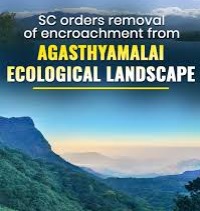
Supreme Court Cracks Down on Agasthyamalai Encroachments: Eviction Plan Ordered
118 Government Officials Among Encroachers Face Disciplinary Action
Court Stresses Constitutional Duty to Protect Fragile Ecosystems
By Legal Reporter
New Delhi: June 03, 2026:
The Supreme Court of India has ordered the eviction of thousands of encroachers from the ecologically sensitive Agasthyamalai hills, stressing that environmental protection cannot be indefinitely postponed due to administrative or logistical challenges. The ruling mandates disciplinary action against government officials found to be encroachers and directs Tamil Nadu to prepare a time-bound eviction plan.
Background of the Case
- Case: A John Kennedy v. State of Tamil Nadu (2026).
- Bench: Justices Vikram Nath and Sandeep Mehta.
- Region: Agasthyamalai landscape spanning Tamil Nadu and Kerala, including Kalakad-Mundanthurai Tiger Reserve, Srivilliputhur-Megamalai Tiger Reserve, and Kanyakumari Wildlife Sanctuary.
- Findings:
- 4,601 encroachers occupying over 5,000 hectares in Srivilliputhur-Megamalai Tiger Reserve.
- 553 encroachers in Kanyakumari Wildlife Sanctuary.
- 118 serving/retired government employees identified as encroachers.
Key Legal Provisions and Rules
1. Forest Conservation Act, 1980
- Restricts non-forest use of forest land without prior approval.
- Encroachments violate this Act, making eviction legally necessary.
2. Wildlife Protection Act, 1972
- Prohibits settlement and construction in protected areas.
- Encroachments threaten biodiversity and critically endangered species.
3. Constitutional Mandate (Articles 48A & 51A(g))
- Directs the State to protect environment and forests.
- Citizens have a duty to safeguard natural resources.
4. Judicial Oversight via Central Empowered Committee (CEC)
- CEC reports highlighted decades of inaction and proliferation of illegal settlements.
- Supreme Court relied on CEC findings to order strict compliance. Hindustan Times Telangana Today
Analytical Insights
- Environmental Governance: The Court emphasized that protecting fragile ecosystems is a constitutional obligation, not optional.
- Accountability: Disciplinary and legal action against government officials marks a strong stance against administrative complicity.
- Restitution: Court directed recovery of environmental restitution and restoration charges from encroachers.
- Implementation Challenges: Resistance from encroachers and logistical difficulties were acknowledged but deemed insufficient to delay action.
- Future Implications: Sets precedent for strict enforcement in other biodiversity hotspots facing encroachment.
FAQs on the Agasthyamalai Eviction Case
Q1. Why did the Supreme Court order eviction?
Because encroachments violated forest and wildlife laws, threatening biodiversity and ecological balance.
Q2. How many encroachers were identified?
Over 4,600 individuals and 118 government officials across reserves and sanctuaries.
Q3. What laws were violated?
Primarily the Forest Conservation Act, 1980 and Wildlife Protection Act, 1972.
Q4. Can government officials be punished?
Yes. The Court ordered disciplinary and legal action against officials found encroaching.
Q5. What role did the CEC play?
The Central Empowered Committee submitted detailed reports on encroachments, guiding the Court’s decision.
Q6. What happens after eviction?
The Court directed ecological restoration to prevent reoccupation and ensure habitat recovery.
Q7. Why is this ruling significant?
It reinforces the constitutional duty to protect ecologically sensitive regions and sets a precedent for strict enforcement.
Q8. Can welfare schemes continue in encroached areas?
No. The Court ordered a moratorium on extending welfare schemes or infrastructure in encroached forest lands.
Conclusion
The Supreme Court’s ruling on the Agasthyamalai hills is a landmark in environmental jurisprudence, reaffirming that ecological protection cannot be compromised for administrative convenience. By ordering eviction, disciplinary action, and ecological restoration, the Court has sent a strong message that encroachments in protected areas will not be tolerated. This case underscores the judiciary’s proactive role in enforcing environmental governance and safeguarding biodiversity for future generations.