
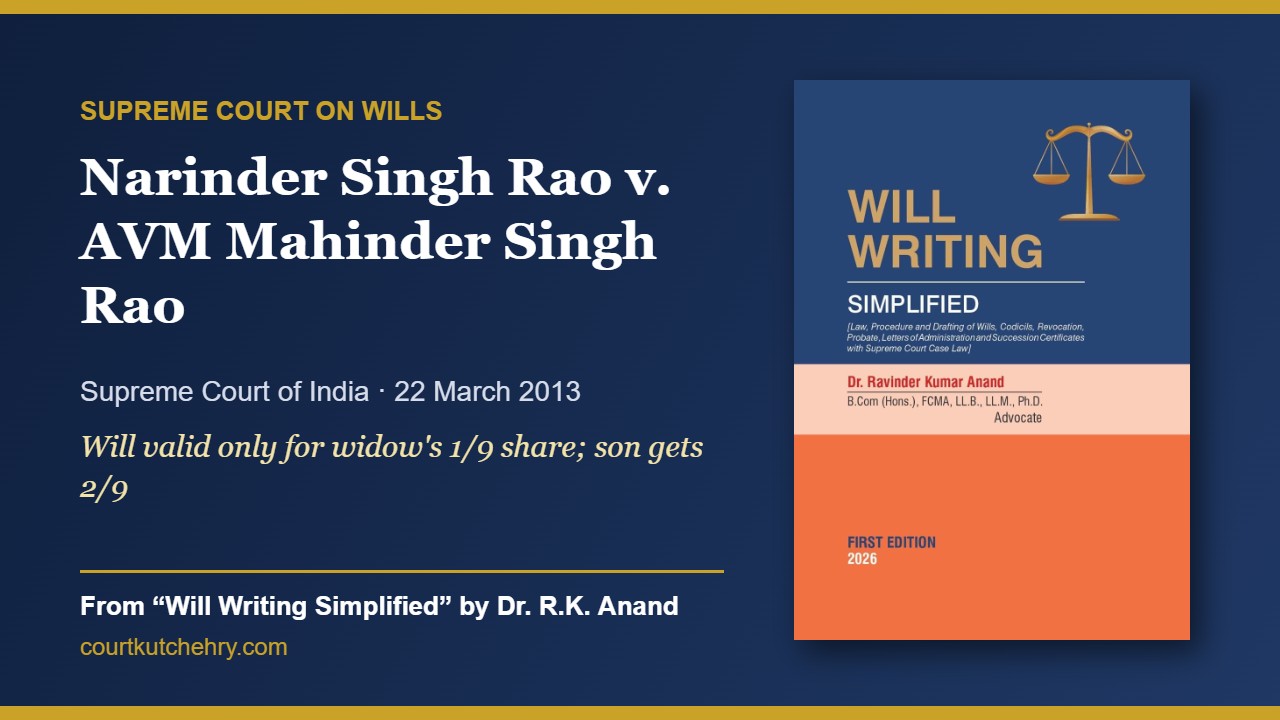
A father writes a note saying that whichever of the couple survives will get the house. He dies; the mother, living with one son, makes a Will leaving the whole house to him and dies five days later. Her other children say the Will is false. On 22 March 2013 the Supreme Court held that the Will was genuine — but that the mother could give away only what she owned, which was a one-ninth share. This article explains Narinder Singh Rao v. Air Vice-Marshal Mahinder Singh Rao & Ors. and what it teaches about the limits of a testator’s power to bequeath.
Case at a Glance
| Case | Narinder Singh Rao v. Air Vice-Marshal Mahinder Singh Rao & Ors. |
|---|---|
| Court | Supreme Court of India |
| Citation | (2013) 03 SC CK 0034; Civil Appeal Nos. 6918–6919 of 2011 |
| Decided on | 22 March 2013 |
| Bench | Justice R.M. Lodha and Justice Anil R. Dave (judgment by Justice Anil R. Dave) |
| Provisions | Hindu Succession Act, 1956; Indian Registration Act, 1908; Benami Transactions (Prohibition) Act, 1988 |
| Result | Appeals dismissed; Will valid only as to the widow’s 1/9 share; appellant holds 2/9 |
The Facts
Rao Gajraj Singh and his wife Sumitra Devi lived in a house built around 1935, recorded in municipal records in his name. Gajraj Singh signed a writing saying that on the death of either spouse, the survivor would inherit the property. It was attested by one relative. It was not registered and did not have two attesting witnesses.
Gajraj Singh died on 29 March 1981. The couple had eight children. Sumitra Devi lived in Ranchi with her son Narinder Singh Rao, the appellant, and in the 1980s built shops on the property and let them out. On 1 June 1989 she executed a Will leaving the property to Narinder. She died on 6 June 1989.
Four of the other children sued, first for a declaration and later, by amendment, for partition. They said the Will was not genuine and that the property should go in eight equal shares.
What the Lower Courts Held
- The trial court dismissed the suit.
- The lower appellate court also dismissed the plaintiffs’ appeal on the main issues. It found the Will valid; it had been attested by two witnesses, an advocate and a medical practitioner.
- The Punjab and Haryana High Court, in a regular second appeal decided on 21 May 2010, partly allowed the plaintiff’s appeal. It held that the property belonged to Gajraj Singh, that he died intestate, and that Sumitra Devi could bequeath only her own share. Narinder appealed to the Supreme Court.
The Question Before the Supreme Court
Did Gajraj Singh’s writing make Sumitra Devi the owner of the whole house? If not, how much could she bequeath by her Will? And could Narinder argue, at the appellate stage, that the house was really hers and only held benami in her husband’s name?
The Law on What a Testator Can Bequeath
A Will can dispose only of property the testator owns or is entitled to. Section 30 of the Hindu Succession Act, 1956 allows a Hindu to dispose of property by Will, but only property “capable of being so disposed of” by him or her. When a Hindu male dies intestate, his property passes under Section 8 of the Act to his Class I heirs — including his widow and his sons and daughters — who take equal shares under Section 10. The widow takes one share like each child, not the whole.
A writing that is meant to operate only on death is testamentary. To be a valid Will it must satisfy Section 63 of the Indian Succession Act, 1925, including attestation by two witnesses. A writing meant to transfer property in the owner’s lifetime is not a Will, and if it transfers immovable property, it needs registration under the Registration Act, 1908.
The Supreme Court’s Reasoning
1. The father’s note had no legal effect
The writing by Gajraj Singh was neither a Will, because it lacked two attesting witnesses, nor a transfer, because it was not registered. It could not make his widow the owner of the whole house (paras 7–8).
2. The house was the father’s, and he died intestate
No evidence showed that the property originally belonged to Sumitra Devi. The finding that it was Gajraj Singh’s property could not be disturbed. Since he left no valid Will, it passed to his widow and eight children: nine heirs, each with 1/9 (para 10).
3. The Will was genuine but limited
The challenges to Sumitra Devi’s health, soundness of mind and free will were rejected on facts, and the Court declined to reappreciate them: “the mental capacity of the testator to execute a Will being a question of fact” (para 16). But she “could not have bequeathed more than her interest in the suit property” (para 11). Put simply, “Sumitra Devi could not have bequeathed under her Will what she did not own” (para 17).
4. A new benami case cannot be raised on appeal
Narinder argued that the house was really his mother’s. That was not pleaded, no issue was framed, and “the issue with regard to the fact could not have been raised before the appellate court for the first time” (para 15).
5. No reason to interfere with facts
The courts below had considered the evidence properly. The Court said “we would not like to interfere with the findings of the fact” (para 12). A dispute about court fee, it added, was between the plaintiff and the court (para 18).
The Final Decision
The Supreme Court dismissed the appeals, with no order as to costs (para 21). The Will of 1 June 1989 operated only on Sumitra Devi’s 1/9 share. Narinder therefore holds 2/9 — his own 1/9 inherited from his father and his mother’s 1/9 under her Will — and each of the other seven children holds 1/9.
Key Takeaways
- A Will can pass only what the testator owns. A valid Will over a larger property operates only on the testator’s share.
- When a Hindu male dies intestate, his widow takes one share equal to each child, not the whole property.
- A note saying “the survivor gets the house”, without two attesting witnesses or registration, has no legal effect.
- Soundness of mind and undue influence are questions of fact, rarely reopened in the Supreme Court.
- A benami or ownership plea must be pleaded at trial; it cannot be raised first in appeal.
Practical Lessons for Will Makers and Lawyers
- Spouses who want the survivor to take everything should each make a proper Will (two attesting witnesses, signed by the testator), or transfer the property by a registered deed.
- Check title before drafting. Ask whether the property is the testator’s own, or a share inherited with others.
- Describe the share in the Will (for example, “my 1/9 undivided share”) when the testator is a co-owner.
- Choose credible, independent witnesses. An advocate and a doctor helped sustain this Will on capacity.
- For lawyers: plead every ownership theory in the written statement. A case not pleaded will not be heard later.
Frequently Asked Questions
Can a widow bequeath her late husband’s house by Will?
Only her own share in it. If her husband died intestate, the house passes to his Class I heirs, and she can bequeath only the share she inherited.
Is a note saying “my wife will get the house after me” a valid Will?
Not unless it is signed by the maker and attested by two witnesses as Section 63 of the Indian Succession Act requires. Here the note had one attesting witness and no effect.
What share did each heir get here?
Each of the nine heirs (widow and eight children) took 1/9. The appellant got 2/9: his own 1/9 and his mother’s 1/9 under her Will.
Was the mother’s Will held invalid?
No. It was held genuine and valid, but effective only to the extent of her 1/9 share.
Why was the benami argument rejected?
Because it was not pleaded, no issue was framed on it, and it was raised for the first time in appeal.
Conclusion
Narinder Singh Rao separates two questions that families often run together: is the Will genuine, and what can it pass? A genuine Will cannot give away property the testator did not own.
For couples, the practical message is to make proper Wills, or registered transfers, while both are alive. An informal note will not stop the law of intestate succession from dividing the property among all the heirs.
Read More in “Will Writing Simplified”

This judgment is one of 123 Supreme Court judgments on Wills summarised in Chapter 14 of Will Writing Simplified by Advocate Dr. Ravinder Kumar Anand. The book covers the law, procedure and drafting of Wills, codicils, revocation, probate, letters of administration and succession certificates, with Supreme Court case law.
Special limited-period offer: available at 50% off on Amazon.
Buy Will Writing Simplified on Amazon →
Research Judgments Like These on CourtKutchehry
Every judgment cited in this article, and lakhs more, can be searched and read on CourtKutchehry. Searching and reading judgments is free. A membership adds unlimited summaries, all related judgments, original court PDF downloads, bookmarks, notes and the CourtKutchehry AI assistant.
| Membership | Price | Works out to | AI credits |
|---|---|---|---|
| Monthly (1 month) | ₹599 | ₹599 / month | 1,000 / month |
| Quarterly (3 months) · Save 16% | ₹1,499 | ₹499.67 / month | 1,100 / month |
| Six-monthly (6 months) · Save 33% | ₹2,399 | ₹399.83 / month | 1,200 / month |
| Yearly (12 months) · Save 44% · Best value | ₹3,999 | ₹333.25 / month | 1,300 / month |
Every plan is a one-off purchase for a fixed period: nothing auto-renews and no card is kept on file. Prices are exclusive of applicable tax, which is added at checkout. Extra AI chat credits can be topped up from ₹99. A free verified account gets 5 summaries and 50 AI trial credits.
Prices are as displayed on courtkutchehry.com on 20 November 2026 and are subject to change without notice. Please check the pricing page for the current plans and offers.
For more judgments, legal opinions and case analysis, visit courtkutchehry.com
Visit CourtKutchehry →