
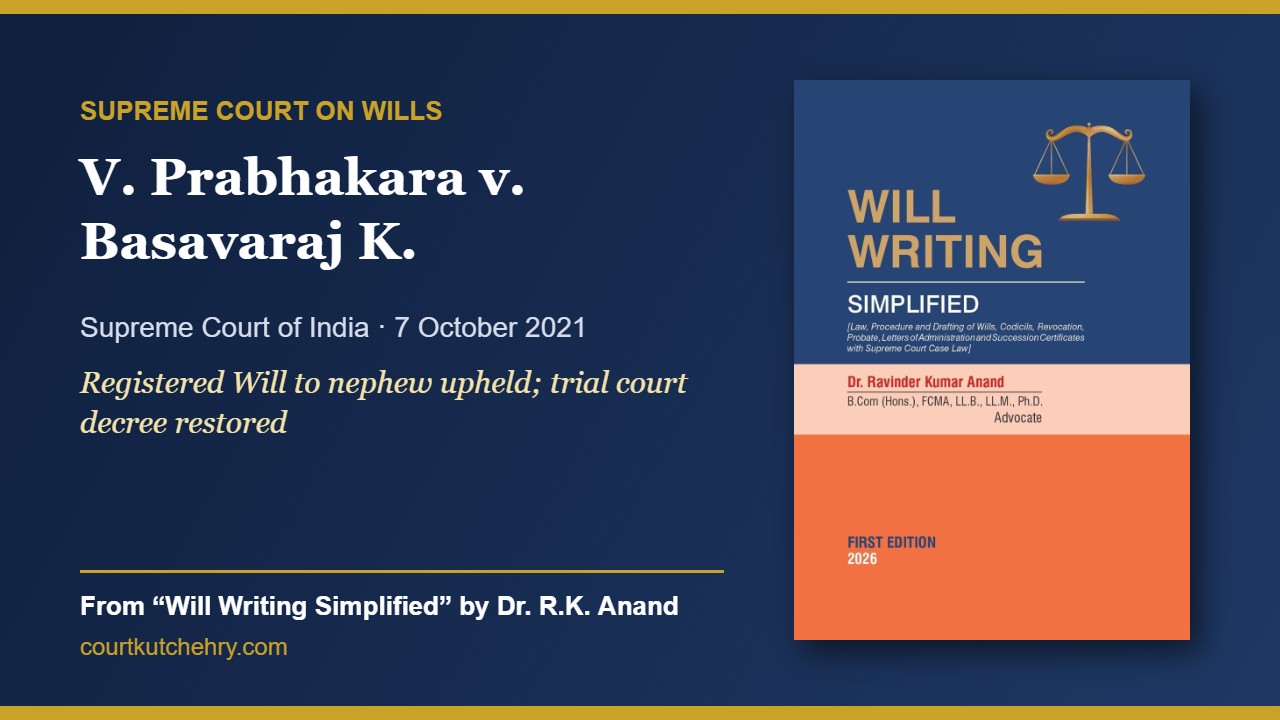
An unmarried aunt, cared for by her nephew after a paralysis attack, leaves him her house by a registered Will. Her brother attests it; her sister takes her to the Sub-Registrar. After her death, the sister’s divorced husband, living in the house, produces a later unregistered Will in favour of his own son. The trial court found that later Will forged and upheld the first. The High Court agreed the later Will was not genuine, yet threw out the registered one too. On 7 October 2021, the Supreme Court restored the nephew’s decree. This article explains V. Prabhakara v. Basavaraj K. (Dead) by LR & Anr. and what it teaches about suspicion, pleadings and first appeals.
Case at a Glance
| Case | V. Prabhakara v. Basavaraj K. (Dead) by LR & Anr. |
|---|---|
| Court | Supreme Court of India |
| Citation | (2021) 10 SC CK 0031; Civil Appeal Nos. 1376–1377 of 2010 |
| Decided on | 7 October 2021 |
| Bench | Justice Sanjay Kishan Kaul and Justice M.M. Sundresh (judgment by Justice M.M. Sundresh) |
| Provisions | Section 63, Indian Succession Act, 1925; Sections 8, 17, 58, 68, 114(e) and 115, Indian Evidence Act, 1872; Sections 17–18, Registration Act, 1908; Section 96 and Orders VI and VIII, CPC |
| Result | Appeals allowed; High Court judgment and review order set aside; trial court decree restored |
The Facts
Ms. Jessie Jayalakshmi, a spinster, was the appellant’s maternal aunt. The appellant said she had treated him as her son and that he looked after her after she suffered a paralysis attack.
On 4 September 1985 she executed a registered Will (Ex. P4) leaving her house to him. Her brother (PW-2) was an attesting witness, and her sister, Kantha Lakshmi, took her to the Sub-Registrar. An independent second attesting witness also gave evidence (PW-3). She died on 22 August 1986.
Kantha Lakshmi later divorced Respondent No. 1, who had been allowed to live in the house. The appellant sued for declaration and possession (O.S. No. 51 of 1992). The defendants admitted the execution of Ex. P4, but relied on an unregistered Will (Ex. D1) dated August 1986, said to be in favour of Respondent No. 1’s son, and on an alleged mortgage of Rs. 31,000 in Respondent No. 1’s favour.
What the Trial Court and High Court Held
- The trial court decreed the suit on 11 December 2003. It held Ex. P4 proved under Section 63 of the Succession Act read with Section 68 of the Evidence Act, and rejected Ex. D1 for a smudged thumb impression, doubtful signature and recitals, an unexamined scribe and weak attesting evidence.
- On first appeal under Section 96 CPC, the High Court (20 September 2006) agreed that Ex. D1 was not genuine. But without any specific pleading, and despite the admitted execution of Ex. P4, it found Ex. P4 suspicious because the testatrix had left out her other siblings, and dismissed the suit. A review petition was dismissed in 2007.
The Question Before the Supreme Court
Could the first appellate court, without pleadings or evidence directed to it, find suspicious circumstances surrounding a registered Will whose execution was admitted and duly proved, and on that basis reverse a reasoned trial decree?
The Law on Proof, Pleadings and First Appeals
The judgment brings together several strands of law:
- Proof of execution: Section 68 of the Evidence Act (now Section 67 of the Bharatiya Sakshya Adhiniyam, 2023), read with Section 63 of the Succession Act, requires at least one attesting witness to be examined. It is mandatory.
- Admissions: facts admitted in the pleadings need not be proved (Section 58 of the Evidence Act, now Section 53 BSA), and a party’s conduct is relevant (Section 8, now Section 6 BSA).
- Registration: a Will is not compulsorily registrable under Sections 17 and 18 of the Registration Act. Registration is a supporting circumstance, not conclusive proof. Official acts, including registration, are presumed regularly performed under Section 114(e) (now Section 119 BSA).
- Pleadings: relief must rest on pleadings and denials must be specific (Orders VI and VIII CPC). An unpleaded point can be considered only if the parties knew it was in issue and led evidence on it, as held in Bachhaj Nahar v. Nilima Mandal.
- First appeal: under Section 96 CPC the appellate court may reappreciate evidence, but must engage with the trial court’s reasoning, as explained in Jagdish Singh v. Madhuri Devi and older cases such as Sarju Pershad v. Jwaleshwari and Madhusudan Das v. Narayanibai.
The Supreme Court’s Reasoning
1. A court of conscience, not of suspicion
The Court put the principle in one line: “A testamentary court is not a court of suspicion but that of conscience” (para 24). Excluding a sibling does not by itself create suspicion unless other circumstances support an inference.
2. Ex. P4 was proved, and its execution admitted
The appellant had complied with Section 63 of the Succession Act and Section 68 of the Evidence Act. The defendants admitted execution of Ex. P4, and the siblings raised no objection to it. Indeed, the respondents’ own Ex. D1 recognised Ex. P4. Against this, “The Appellate Court, in our considered view, has unnecessarily created a suspicion when there is none” (para 25).
3. The sister’s presence helped, not hurt
The High Court had treated the involvement of the sister as a ground for doubt. The Supreme Court held the opposite: “Her presence in fact adds strength to Exhibit P4 having been executed properly” (para 26). The very relatives who were left out had taken part in the execution and never objected.
4. The High Court did not deal with the trial court’s reasons
The trial court’s findings were reasoned, there was no contrary pleading, and the High Court gave no real reasons for reversing them. The Court reiterated that “A mere substitution of views, without discussing the findings of the trial court, by the appellate court is not permissible” (para 21).
5. The respondent’s own conduct
Respondent No. 1, the appellant’s former brother-in-law, could not attack Ex. P4 while relying on Ex. D1, which had been found not genuine, and his mortgage claim was not proved. The High Court should have considered his conduct, including the divorce and his continued occupation of the house.
The Final Decision
The Supreme Court allowed the appeals, set aside the High Court’s judgment and its review order, and restored the trial court’s decree in O.S. No. 51 of 1992 in favour of the appellant, without costs (para 30).
Key Takeaways
- Suspicion must arise from pleadings and evidence, not from the court’s own view of what a fair Will looks like.
- Leaving out siblings or other relatives is not, by itself, a suspicious circumstance.
- Registration of a Will is not compulsory, but it is a supporting circumstance in favour of genuineness.
- Where execution is admitted and proved, the propounder’s burden is largely discharged.
- A first appellate court must engage with the trial court’s reasons before reversing findings of fact.
Practical Lessons for Will Makers and Lawyers
- Involve family openly. Here the testatrix’s brother attested and her sister accompanied her. That openness defeated the later attack.
- Register the Will where possible, and add an independent witness, as was done here.
- Explain your choice of beneficiary, for example years of care during illness.
- For lawyers defending a Will: object if the opposite side relies on suspicious circumstances that were never pleaded.
- For lawyers in first appeals: address each finding of the trial court. A bare substitution of views will not survive scrutiny.
Frequently Asked Questions
Is a Will that leaves out brothers and sisters suspicious?
Not by itself. The Court held that exclusion of a sibling does not create suspicion unless other circumstances support it.
Must a Will be registered?
No. Registration is optional under the Registration Act, 1908. But a registered Will carries a presumption that the registration was regularly done, which supports its genuineness.
Can a court raise suspicious circumstances no party pleaded?
Generally no. Relief must rest on pleadings, and an unpleaded point can be considered only if the parties knew it was in issue and led evidence on it.
What does “court of conscience” mean?
It means the court must be genuinely satisfied that the Will is the testator’s free and conscious act. It does not mean the court should look for reasons to doubt a properly proved Will.
What must a first appellate court do before reversing a trial court?
It must examine the evidence, deal with the trial court’s reasoning, keep in mind that the trial judge saw the witnesses, and record cogent reasons for differing.
Conclusion
V. Prabhakara is a firm reminder that suspicion is a matter of evidence, not instinct. A registered Will, admitted and duly proved, executed with the knowledge and help of the very relatives left out, does not become doubtful merely because a court thinks the distribution could have been different.
The judgment also sets a clear standard for first appeals: engage with the trial court’s reasons, or leave its findings alone.
Read More in “Will Writing Simplified”

This judgment is one of 123 Supreme Court judgments on Wills summarised in Chapter 14 of Will Writing Simplified by Advocate Dr. Ravinder Kumar Anand. The book covers the law, procedure and drafting of Wills, codicils, revocation, probate, letters of administration and succession certificates, with Supreme Court case law.
Special limited-period offer: available at 50% off on Amazon.
Buy Will Writing Simplified on Amazon →
Research Judgments Like These on CourtKutchehry
Every judgment cited in this article, and lakhs more, can be searched and read on CourtKutchehry. Searching and reading judgments is free. A membership adds unlimited summaries, all related judgments, original court PDF downloads, bookmarks, notes and the CourtKutchehry AI assistant.
| Membership | Price | Works out to | AI credits |
|---|---|---|---|
| Monthly (1 month) | ₹599 | ₹599 / month | 1,000 / month |
| Quarterly (3 months) · Save 16% | ₹1,499 | ₹499.67 / month | 1,100 / month |
| Six-monthly (6 months) · Save 33% | ₹2,399 | ₹399.83 / month | 1,200 / month |
| Yearly (12 months) · Save 44% · Best value | ₹3,999 | ₹333.25 / month | 1,300 / month |
Every plan is a one-off purchase for a fixed period: nothing auto-renews and no card is kept on file. Prices are exclusive of applicable tax, which is added at checkout. Extra AI chat credits can be topped up from ₹99. A free verified account gets 5 summaries and 50 AI trial credits.
Prices are as displayed on courtkutchehry.com on 20 November 2026 and are subject to change without notice. Please check the pricing page for the current plans and offers.
For more judgments, legal opinions and case analysis, visit courtkutchehry.com
Visit CourtKutchehry →