
Case at a Glance
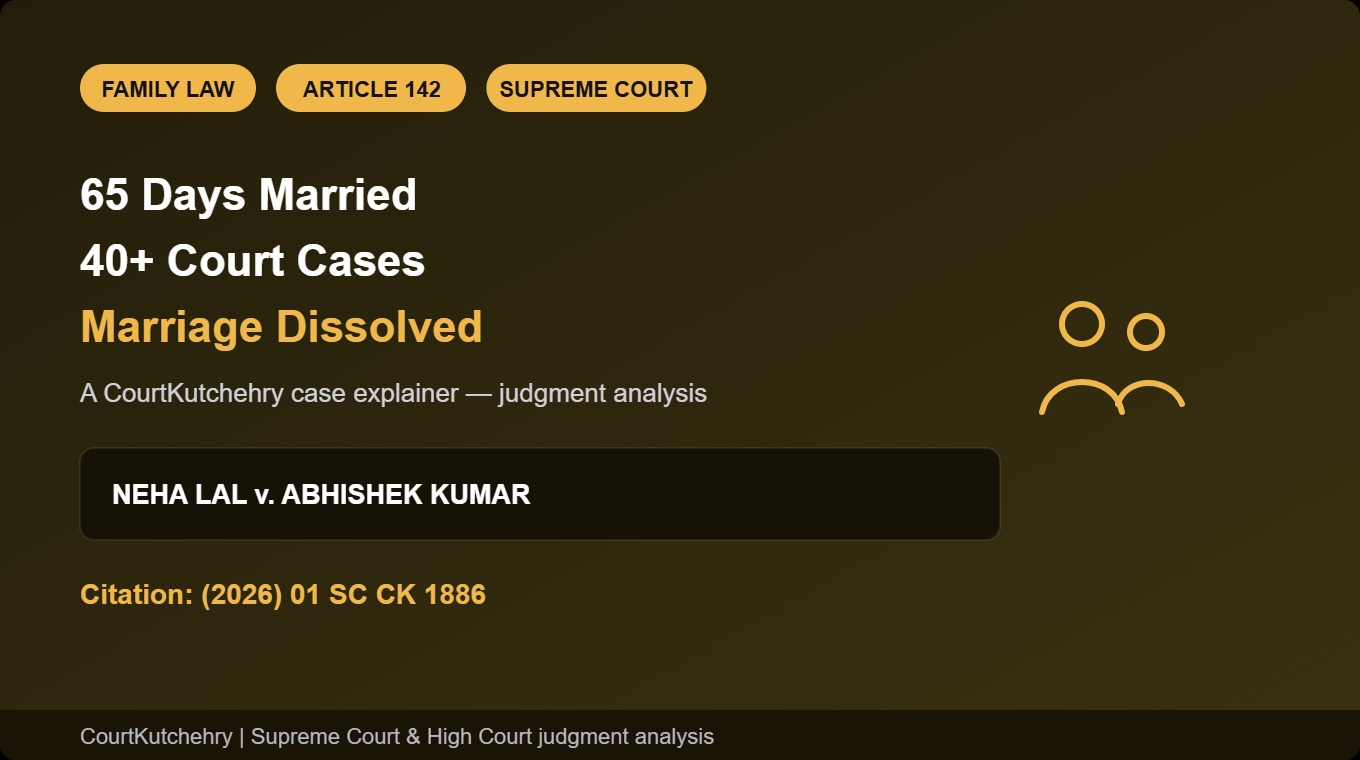
The couple married on 28 January 2012 and lived together for only about 65 days before separating on 2 April 2012. Over the next decade they filed more than 40 cases against each other in Family Courts, criminal courts and two High Courts. On the wife’s transfer petition, the Supreme Court dissolved the marriage under Article 142 even though the husband refused consent, closed the pending matrimonial litigation, barred fresh litigation on the dispute, kept alive only the perjury applications, and imposed costs of ₹10,000 on each party.
The wife sought transfer of the husband’s application under Section 340 CrPC — seeking perjury proceedings against her for an allegedly false financial affidavit — from the Family Court at Karkardooma, Delhi to Lucknow. She also filed an application asking the Court to dissolve the marriage under Article 142 for irretrievable breakdown. Each side blamed the other for the separation; there was no child of the marriage, and both parties were educated.
Because the lists of cases filed by the parties did not match, the Court asked the Registrars General of the Delhi and Allahabad High Courts to verify them. The verified list included revision petitions and writ petitions in the Delhi High Court, a Section 482 petition in the Allahabad High Court, maintenance and execution proceedings, criminal cases at Ghaziabad and divorce petitions in Delhi and Lucknow. A reference to the Supreme Court Mediation Centre on 22 July 2025 did not take off. The husband, appearing in person, opposed divorce and said the wife wanted it only to escape the perjury proceedings.
The Key Question Before the Court
Can the Supreme Court dissolve a marriage under Article 142 for irretrievable breakdown when one spouse refuses consent, and what happens to the dozens of pending cases between them?
Breakdown Beyond Salvage, Litigation as a Weapon
Irretrievable breakdown is not a ground for divorce under the Hindu Marriage Act, 1955, but the Constitution Bench in Shilpa Sailesh v. Varun Sreenivasan, (2023) 05 SC CK 0001 held that Article 142(1) allows the Court to dissolve a marriage that has broken down beyond salvage, even over one party’s opposition, to do complete justice. Relying also on Rakesh Raman v. Kavita, (2023) 04 SC CK 0103 and other decisions, the Court said repeated litigation and failed mediation are strong indicators of breakdown. It quoted Achin Gupta v. State of Haryana, (2024) 05 SC CK 0016 on the misuse of criminal proceedings in matrimonial disputes.
On the facts, the Court found “a clear case of irretrievable breakdown of marriage”: the parties had lived together for only 65 days and had been litigating for over a decade. It warned that “Warring couples cannot be allowed to settle their scores by treating Courts as their battlefield and choke the system.” It urged that matrimonial disputes should first be taken to pre-litigation mediation before criminal proceedings are set in motion. The husband’s refusal to consent did not outweigh the absence of any prospect of reunion.
What the Court Actually Held
- The marriage was dissolved under Article 142; no alimony was claimed, and all claims between the parties stand settled.
- All verified pending matrimonial cases stand disposed of, and any other matrimonial case not listed will also be disposed of on production of the order.
- The parties may not start any further litigation on the matrimonial dispute; only the specified perjury applications under Section 340 CrPC / Section 379 BNSS survive, to be decided on merits.
- Each party must deposit costs of ₹10,000 with the Supreme Court Advocates-on-Record Association; the transfer petition was disposed of.
Why This Judgment Matters
- It shows the Court will use Article 142 to end hopeless marriages even without both spouses’ consent.
- It treats a flood of cross-cases as evidence of breakdown and as a burden on the justice system.
- It separates matrimonial claims (closed) from perjury allegations (kept alive), so false affidavits are not excused by divorce.
What Should Advocates Take Away From the Judgment?
For Spouses
- Filing case after case does not help; the Court may end the marriage and close every pending dispute in one order.
- Mediation before criminal complaints is what the Court expects in matrimonial disputes.
For Counsel
- Rely on Shilpa Sailesh v. Varun Sreenivasan for Article 142 divorce without mutual consent.
- Prepare a verified list of all cases between the parties; the Court here had it verified by the High Court Registries.
Key Takeaways
- Article 142 divorce is possible even if one spouse refuses.
- Short cohabitation plus long litigation points to irretrievable breakdown.
- Pending matrimonial cases can be closed together, with a bar on fresh litigation.
- Perjury applications for false affidavits may still survive the divorce.
Frequently Asked Questions
Can the Supreme Court grant divorce if my spouse does not agree?
Yes, under Article 142 where the marriage has broken down beyond repair, as held in Shilpa Sailesh v. Varun Sreenivasan. Here the husband’s objection was overruled.
What happened to the 40-odd cases between the couple?
The verified pending matrimonial cases were disposed of and the parties were barred from fresh matrimonial litigation, but specified perjury applications were left to be decided on merits.
Was any alimony ordered?
No. The judgment records that no alimony was claimed and that all claims between the parties stand settled.
Conclusion
The Court’s message is direct: a 65-day marriage cannot be allowed to generate a decade of litigation that clogs courts across two States.
Practical takeaway: In long-running matrimonial wars, an Article 142 application before the Supreme Court can bring every case to an end at once — but allegations of false affidavits may still have to be faced.
Read the full judgment on CourtKutchehry: View judgment →
For more judgments, legal opinions and case analysis, visit courtkutchehry.com