
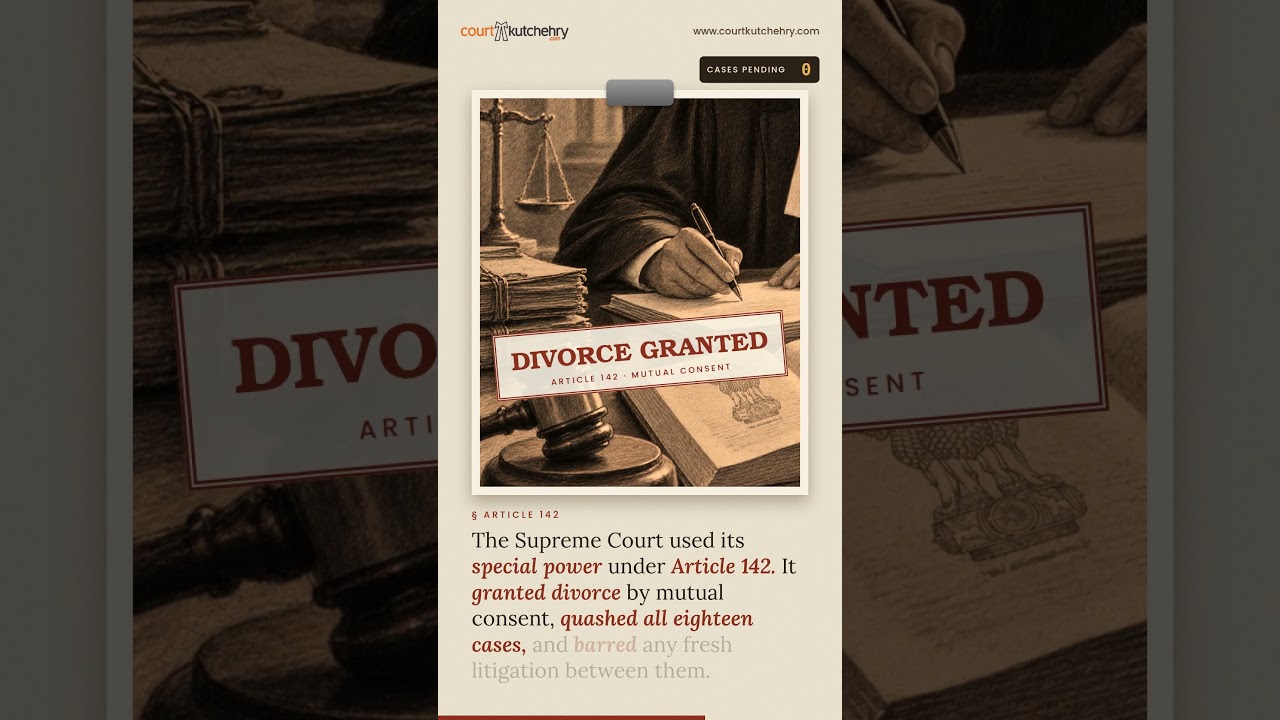
Watch the Video
In this short video, CourtKutchehry explains a Supreme Court judgment of 28 September 2026 in which one order brought 18 matrimonial cases to an end. This article explains the facts, what the Court did under Article 142 of the Constitution, and why.
A Marriage That Became 18 Cases
The parties married on 4 December 2016 and had been living separately since 2022. What followed is familiar to every family lawyer: a divorce petition, complaints in Noida, domestic violence and Section 498A IPC proceedings in Mumbai, matters before the Orissa and Delhi High Courts, and transfer petitions in the Supreme Court. In all, 18 civil and criminal proceedings were pending in Odisha, Maharashtra, Delhi and Uttar Pradesh.
The case is reported as S v. State of Odisha & Ors. (2026 INSC 1060). The parties’ names are redacted, and we do not name them.
Mediation, Then Settlement
The husband asked the Court to dissolve the marriage under Article 142 on the ground of irretrievable breakdown and to close all the litigation. Mediation initially failed. The parties were referred to the Supreme Court Mediation Centre in February 2026. Eventually the wife agreed to a mutual consent divorce, and the alimony was settled at ₹35 lakh after the husband raised his offer from ₹15 lakh at the Court’s suggestion.
What the Court Did Under Article 142
A Bench of Justice B.V. Nagarathna and Justice R. Mahadevan found that the marriage had come to a dead end. Using its power to do “complete justice” under Article 142, the Court:
- dissolved the marriage by mutual consent;
- quashed all 18 pending proceedings between the parties;
- directed that neither party would initiate fresh proceedings against the other;
- recorded ₹35 lakh as permanent alimony in full and final settlement (₹2 lakh already paid and ₹33 lakh by demand drafts handed over in Court); and
- disposed of the transfer petitions and directed a decree to be drawn up.
Why Article 142 and Not Case by Case?
Without this order, each of the 18 cases would have had to be withdrawn, compromised or decided separately, in four States. Article 142 lets the Supreme Court pass one order that ends the whole dispute. The Court relied on its earlier decisions, including the Constitution Bench ruling in Shilpa Sailesh v. Varun Sreenivasan, (2023) 05 SC CK 0001 and Rinku Baheti v. Sandesh Sharda, (2025) 3 SCC 686.
In Shilpa Sailesh (2023), the Constitution Bench held that the Supreme Court can dissolve a marriage under Article 142 on irretrievable breakdown, can dispense with the waiting period for mutual consent divorce under Section 13B of the Hindu Marriage Act, and can quash related proceedings to do complete justice. The Court also said, in the present case, that settlement, and not litigation, is the preferable mode of resolving such disputes.
Remember this line: Article 142 is used to end a dispute completely, not one case at a time.
A Note of Caution
This is a discretionary power used on the facts of each case. It worked here because both parties genuinely settled. It is not a right that one spouse can demand, and it is not available in every court: High Courts and Family Courts do not have Article 142 powers.
Key Takeaways
- The parties married in 2016, separated in 2022 and ended up in 18 civil and criminal cases across four States.
- Under Article 142, the Supreme Court granted divorce by mutual consent and quashed all 18 proceedings in one order.
- Neither party may start fresh proceedings against the other.
- ₹35 lakh was recorded as permanent alimony in full and final settlement.
- The Court relied on Shilpa Sailesh (2023), which recognises its power to grant divorce and quash connected cases under Article 142.
Frequently Asked Questions
What is Article 142?
It empowers the Supreme Court to pass any decree or order necessary for doing complete justice in any cause or matter pending before it.
Can a Family Court use Article 142?
No. The power belongs only to the Supreme Court.
Did the Court quash criminal cases too?
Yes. The 18 proceedings included criminal matters such as Section 498A IPC and domestic violence proceedings, and all were quashed.
Who decided the case?
Justice B.V. Nagarathna and Justice R. Mahadevan, on 28 September 2026.
Can either party file a new case later?
The Court directed that neither party would initiate fresh proceedings against the other.
Where can I watch the video?
Watch the short explainer on the CourtKutchehry YouTube channel: https://youtu.be/j9ePZVg8KVA.
Conclusion
This judgment shows Article 142 at its most practical: one order replacing years of parallel litigation in many courts.
The key was a genuine settlement. Where both sides have truly moved on, the Supreme Court can give them complete and final closure.
▶ Watch the video: 18 Cases Ended by ONE Supreme Court Order | How Article 142 Brought Final Closure
📖 Read more: One Application, 18 Cases Ended: Supreme Court Grants Divorce Under Article 142 With Rs 35 Lakh Alimony
Research Judgments Like These on CourtKutchehry
Every judgment cited in this article, and lakhs more, can be searched and read on CourtKutchehry. Searching and reading judgments is free. A membership adds unlimited summaries, all related judgments, original court PDF downloads, bookmarks, notes and the CourtKutchehry AI assistant.
| Membership | Price | Works out to | AI credits |
|---|---|---|---|
| Monthly (1 month) | ₹599 | ₹599 / month | 1,000 / month |
| Quarterly (3 months) · Save 16% | ₹1,499 | ₹499.67 / month | 1,100 / month |
| Six-monthly (6 months) · Save 33% | ₹2,399 | ₹399.83 / month | 1,200 / month |
| Yearly (12 months) · Save 44% · Best value | ₹3,999 | ₹333.25 / month | 1,300 / month |
Every plan is a one-off purchase for a fixed period: nothing auto-renews and no card is kept on file. Prices are exclusive of applicable tax, which is added at checkout. Extra AI chat credits can be topped up from ₹99. A free verified account gets 5 summaries and 50 AI trial credits.
Prices are as displayed on courtkutchehry.com on 20 November 2026 and are subject to change without notice. Please check the pricing page for the current plans and offers.
For more judgments, legal opinions and case analysis, visit courtkutchehry.com
Visit CourtKutchehry →