
Watch the Video
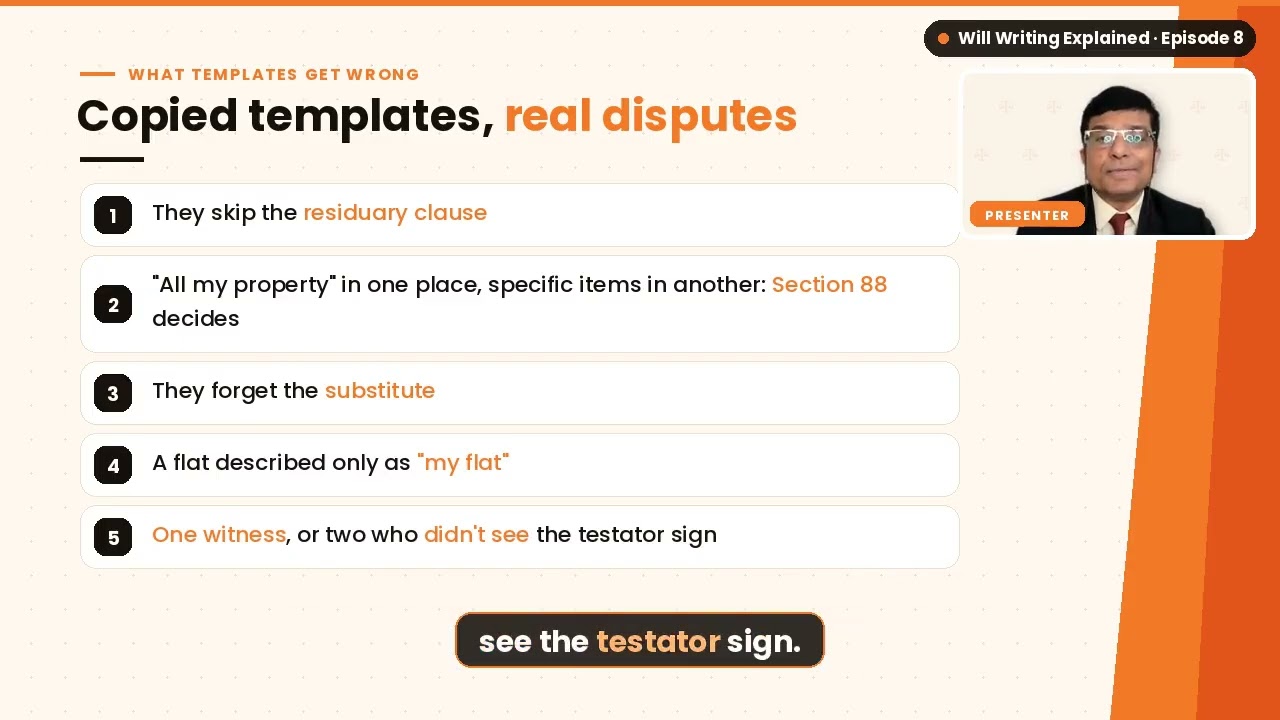
In this 11-minute video, CourtKutchehry presents Episode 8 of “Will Writing Explained”, based on the book “Will Writing Simplified” by Dr. Ravinder Kumar Anand, Advocate. A father leaves his flat to his son and his savings to his daughter. Years later he sells the flat, his daughter dies before him, and his son signs the will as a witness. When the father dies, almost nothing in that will works. The episode goes through the most common mistakes in Indian wills, and what the Indian Succession Act, 1925 does when life changes after the will is signed. This article follows the same questions.
Q1. Can a Beneficiary Sign as a Witness? (Section 67)
Mistake 1: using a beneficiary, or a beneficiary’s spouse, as an attesting witness.
Section 67 of the Indian Succession Act says that such a will is not insufficiently attested; it stays valid. But the gift to the witness, or to the witness’s husband or wife, is void. In the story above, the son who signed as a witness would lose the gift made to him.
Section 67 applies to wills governed fully by the Act, such as those of Christians and Parsis. It is not among the sections that Schedule III extends to wills of Hindus, Buddhists, Sikhs and Jains, so for them the gift may not fail automatically. But it still invites a challenge, which leads to the next mistake.
Mistake 2: letting the main beneficiary run the process. In H. Venkatachala Iyengar v. B.N. Thimmajamma, (1958) 11 SC CK 0008, the Supreme Court explained that where the propounder takes a prominent part in the execution of a will that confers a substantial benefit on him, that is a suspicious circumstance which he must clearly explain. Use independent witnesses who receive nothing, and keep beneficiaries out of the arrangements.
Q2. Vague Words, Property That Isn’t Yours, and No Residuary Clause
Mistake 3: vague descriptions. “My house” when you own two; “my bank money” when you have five accounts. Describe each asset so a stranger can identify it, preferably in a schedule.
Mistake 4: bequeathing what is not yours. A Hindu can will only property he or she owns, including an undivided coparcenary interest, under Section 30 of the Hindu Succession Act, 1956, not the shares of other coparceners or property standing in a spouse’s name.
Mistake 5: no residuary clause. Anything not mentioned in the will passes by intestacy, which may defeat your whole plan. Always add a clause giving “all the rest and residue” of your property to someone.
Q3. What If the Beneficiary Dies Before Me? (Sections 105 and 109)
Mistake 6: naming no substitute. Under Section 105, if a legatee does not survive the testator, the legacy lapses and falls into the residue (or passes by intestacy if there is no residuary clause). Section 109 gives one exception: a bequest to the testator’s own child or lineal descendant does not lapse if that person leaves a lineal descendant who survives the testator.
In the opening story, whether the daughter’s gift survives depends on whether she left a child. Do not leave it to chance: name a substitute for every gift.
Q4. I Sold the Property I Left in My Will (Section 152)
Mistake 7: not reviewing the will after a sale or purchase. A will speaks from death. Under Section 152, a specific legacy, such as “my flat at a named address”, is adeemed if that property does not belong to the testator at his death. The son in the story gets neither the flat nor its sale price, unless the will says so.
The same problem arises in reverse: a flat bought after the will, and not covered by a residuary clause, passes by intestacy. Review your will after every major sale or purchase.
Q5. Does Marriage or Divorce Cancel a Will? (Section 69)
Mistake 8: assuming life events change the will automatically.
- Marriage. Section 69 provides that a will is revoked by the marriage of its maker. But this rule does not apply to Hindus, Buddhists, Sikhs and Jains, because Section 69 is not extended to their wills by Schedule III. For them, a will made before marriage survives the marriage.
- Divorce. The Act contains no rule that divorce revokes a will. A gift to a former spouse remains unless the testator changes the will.
So review the will after every marriage, divorce, birth and death in the family.
Remember this line: life changes the family, but only the testator can change the will.
Q6. Can I Cross Out a Line in My Will? (Section 71 and Codicils)
Mistake 9: making handwritten changes after signing. Under Section 71, an obliteration, interlineation or other alteration made in an unprivileged will after its execution has no effect (except to the extent the original words have been made illegible), unless the alteration is itself executed like a will, signed by the testator and attested by two witnesses.
The proper ways to change a will are:
- a codicil (Section 2(b)): a separate instrument that explains, alters or adds to the will, executed with the same formalities; or
- a fresh will that expressly revokes all earlier wills and codicils, which is usually cleaner when the changes are many.
Q7. Excluding an Heir Without Reason, and a Will No One Can Find
Mistake 10: silence and secrecy. Two final errors often appear together:
- Excluding a natural heir without a word of explanation. Exclusion is lawful, but an unexplained one is the commonest ground of attack. A short, truthful reason (“already provided for by gift of the shop in 2015”) helps the court see the will as natural.
- Hiding the will so well that nobody finds it. A will that is never found cannot be acted on. Tell the executor where it is, keep a copy separately, or deposit the original in a sealed cover with the Registrar under Sections 42 to 46 of the Registration Act, 1908.
The Ten Mistakes at a Glance
- A beneficiary or his spouse as witness.
- The beneficiary arranging the will.
- Vague descriptions of property.
- Giving away property that is not yours.
- No residuary clause.
- No substitute for a beneficiary who may die first.
- Not reviewing after selling or buying property.
- Not reviewing after marriage, divorce, birth or death.
- Crossing out or adding words after signing.
- Excluding an heir without reason, and losing the original.
Key Takeaways
- Under Section 67, a will attested by a beneficiary or his spouse stays valid, but the gift to that witness is void; for Hindu wills it may not apply, but invites challenge.
- A beneficiary taking a prominent part in making the will is a suspicious circumstance (H. Venkatachala Iyengar).
- A legacy lapses if the legatee dies first (Section 105), except a gift to the testator’s child who leaves a lineal descendant (Section 109). Name substitutes.
- Selling a specifically bequeathed asset adeems the legacy (Section 152). Review the will after big transactions.
- Marriage revokes a will under Section 69, but not for Hindus, Buddhists, Sikhs and Jains; divorce does not revoke a will.
- Unattested alterations have no effect (Section 71); use a codicil or a fresh will, and keep the original safe.
Frequently Asked Questions
Is a will invalid if a beneficiary signs as a witness?
No. Under Section 67 the will remains valid, but the gift to that witness or his or her spouse is void. Section 67 is not extended to Hindu wills by Schedule III, but such attestation still invites challenge.
Does marriage cancel an earlier will?
Under Section 69 a will is revoked by the maker’s marriage, but that section does not apply to Hindus, Buddhists, Sikhs and Jains. For them, the will survives marriage.
Does divorce cancel a will?
No. The Indian Succession Act has no rule that divorce revokes a will, so a gift to a former spouse remains until the testator changes the will.
Can I make changes to my will by hand after signing it?
Not effectively. Under Section 71, unattested alterations made after execution have no effect. Make a codicil or a fresh will with signature and two witnesses.
What happens if I sell a property I left to someone in my will?
The specific legacy is adeemed under Section 152, so the beneficiary gets nothing in its place unless the will provides otherwise.
Where can I watch the full explanation?
Watch the full explanation in 11 minutes: https://youtu.be/CkCbbenX43E.
Conclusion
Most wills do not fail because of fraud or forgery. They fail because of ordinary mistakes: a beneficiary as witness, a gift with no substitute, a flat sold and never replaced, a line crossed out by hand, or an original nobody can find.
Each mistake has a simple cure: independent witnesses, a residuary clause, a substitute for every gift, a review after every major life event, codicils instead of corrections, and a safe, known place for the original.
▶ Watch the video: 10 Common Mistakes That Can Ruin a Will | Will Writing Explained – Ep 8 | Courtkutchehry
Research Judgments Like These on CourtKutchehry
Every judgment cited in this article, and lakhs more, can be searched and read on CourtKutchehry. Searching and reading judgments is free. A membership adds unlimited summaries, all related judgments, original court PDF downloads, bookmarks, notes and the CourtKutchehry AI assistant.
| Membership | Price | Works out to | AI credits |
|---|---|---|---|
| Monthly (1 month) | ₹599 | ₹599 / month | 1,000 / month |
| Quarterly (3 months) · Save 16% | ₹1,499 | ₹499.67 / month | 1,100 / month |
| Six-monthly (6 months) · Save 33% | ₹2,399 | ₹399.83 / month | 1,200 / month |
| Yearly (12 months) · Save 44% · Best value | ₹3,999 | ₹333.25 / month | 1,300 / month |
Every plan is a one-off purchase for a fixed period: nothing auto-renews and no card is kept on file. Prices are exclusive of applicable tax, which is added at checkout. Extra AI chat credits can be topped up from ₹99. A free verified account gets 5 summaries and 50 AI trial credits.
Prices are as displayed on courtkutchehry.com on 20 November 2026 and are subject to change without notice. Please check the pricing page for the current plans and offers.
For more judgments, legal opinions and case analysis, visit courtkutchehry.com
Visit CourtKutchehry →